See Rock City

See Rock City

Thursday, September 29, 2011

The Moon Pie


The MoonPie brand logo

A moon pie or MoonPie is a pastry which consists of two round graham cracker cookies, with marshmallow filling in the center, dipped in chocolate or other flavors. The traditional pie is about three inches (76 mm) in diameter. A smaller version exists (mini MoonPie) that is about half the size, and a Double-Decker MoonPie of the traditional diameter features a third cookie and attendant layer of marshmallow. The four main flavors are chocolate, vanilla, strawberry, and banana. Double Decker MoonPies also come in lemon and orange; MoonPie Crunch comes only in peanut butter or mint.

History And Orgin


A double-decker Moon Pie split in half

Marshmallow creme (fluff) began shipping outside of New England in late 1917. By 1919, fluff had made its way to Chattanooga, Tennessee. During that year, the coal mines near Chattanooga started selling marshmallow creme in their company store, and the miners soon began dipping graham crackers into the fluff. A salesman for the Chattanooga Bakery, Earl Mitchell, Sr., noticed this practice when he stopped by on his bakery goods route. Pretty soon, the only sales that were made by the bakery salesman were for graham crackers. He asked one of the miners about the snack and wound up discussing a "prototype" product with them. Later when Mitchell was explaining his low sales to M.P. (Mitchell Poe) Shauf, the general foreman and chef for the Chattanooga Bakery, he gave Shauf the idea for the Moon Pie. M. P. Shauf decided to make something for the miners to buy. One day in late 1919, after several different recipes, he made a full size pie with graham crackers and marshmallow fluff. That same day, he had his 3-year-old grandson, Stanley Shauf with him at the bakery and offered his grandson a pie to taste. Because the pie had small indentions where the marshmallow cream was cooked and bubbles had popped, Stanley said it looked like the moon. M.P. Shauf yelled “Moon Pie" so loud that it scared his grandson to tears.

It is uncertain whence the tradition of eating moon pies with RC Cola derived, although it is likely that their inexpensive prices, combined with their larger serving sizes, contributed to establishing this combination as the "working man's lunch". The popularity of this combination was celebrated in a popular song of the 1950's, by Big Bill Lister, "Gimmee an RC Cola and a Moon Pie."

Since New Year's Eve 2008, the city of Mobile, Alabama raises a 12-foot-tall (3.7 m) lighted mechanical moon pie to celebrate the coming of the new year. The giant banana colored MoonPie is raised by a crane to a height of 200 feet (61 m) as the clock strikes midnight. Also, the city had for the 2008 New Year's celebration the world's largest moon pie baked for the occasion. It weighed 55 pounds (25 kg) and contained 45,000 calories.

There is a Moon Pie and RC Festival in Bell Buckle, Tennessee, and a Moon Pie Eating Contest in Bessemer, Alabama.

On October 16, 2010, Sonya Thomas, a competitive eater known as the "Black Widow," ate 38 MoonPies in eight minutes in Caruthersville, Missouri.

Nutrition Facts


Single-layer Moon Pie

A MoonPie is made with marshmallow, which is a low-fat but high-sugar food. The nutritional content of a chocolate full-size or Mini MoonPie (from 2004) is detailed below, showing (full-size) 226 calories, saturated fat 3.5g, carbohydrate 40g, protein 4g, iron 5%, of a total weight of 57 grams (2 ounces). The nutritional data for a chocolate Mini MoonPie is about 65% the amount of full-size.

The ingredients are as follows: Enriched wheat flour (Niacin, Reduced Iron, Thiamine mononitrate, Riboflavin, Folic acid), Corn Syrup, High Fructose Corn Syrup, Sugar, Vegetable Shortening (Contains Partially hydrogenated Soybean Oil and/or Cottonseed Oil and/or Coconut Oil and/or Palm kernel oil and/or Palm Oil), Soy Flour, Dutched Cocoa (Processed With Alkali), Cocoa, Gelatin, Baking Soda, Lecithin, Salt, Artificial Flavoring, Sodium sulfite.

Nutrition facts for chocolate MoonPie (full-size):

Serving size: 1 (57g or 2 oz)

Calories: 226 Calories from fat: 51

Total fat: 5.7g (saturated fat 3.5g) Cholesterol: 0mg Sodium: 188mg

Total Carbohydrate: 40g (dietary fiber 0g, sugars 12.5g)

Protein: 4g Vitamin A: 0% Vitamin C: 0% Iron: 5%.

Nutrition facts for chocolate Mini MoonPie:

Serving size: 1 (34g or 1.2 oz)

Calories: 152 (or 130[8]) Calories from fat: 40 (or 30)

Total fat: 4.5g (saturated fat 3g) Cholesterol: 0mg Sodium: 120mg

Total Carbohydrate: 26g (dietary fiber 0g, sugars 8g)

Protein: 2.5g.

Note that the nutrition data is for a chocolate MoonPie or chocolate Mini MoonPie, while other flavors (such as banana, vanilla, strawberry, or orange) might have different nutritional content.

Similar Products

In the northern regions of the United States, a similar product, manufactured by Burry's, was called a "Scooter Pie"; currently Chattanooga Bakery makes a product of the same name for some markets. Also, compare with Mallomars, a single-cracker marshmallow cookie. In the UK, Australia and Canada there are Wagon Wheels, introduced under the Weston name in the 1940's but since divested to other companies in the UK and Australia. The Korean company Orion and the Korean conglomerate Lotte produce Choco Pies and in Mexico is a similar cookie pie called Mamut. The Turkish food manufacturer Ülker also makes a similar product called "Halley".
Mardi Gras Tradition

The Moon Pie became a traditional "throw" (an item thrown from a parade float into the crowd) of Mardi Gras "krewes" (parade participants) in Mobile, Alabama during 1956, followed by other communities along the Mississippi Gulf Coast. The westernmost outpost of the Moon Pie as an important Carnival throw is Slidell, Louisiana, which has a parade by "The Krewe of Mona Lisa and Moon Pie." Also, in the town of Oneonta, Alabama, there is a moon pie eating contest started by Wal-Mart employee John Love when he inadvertently ordered too many. This anecdote was featured in Sam Walton's autobiography, Made in America.

Links:

Official Chattanooga Bakery website

Pictures

Alfajor

Chocolate-coated marshmallow treats

Choco Pie

Wagon Wheels

Source: Wikipedia

Wednesday, September 28, 2011

Royal Crown Cola


RC Cola (or Royal Crown Cola) is a soft drink developed in 1905 by Claude A. Hatcher, a pharmacist in Columbus, Georgia, United States.

History

The first product in the Royal Crown line was Chero-Cola in 1904, followed by Royal Crown Ginger Ale, Royal Crown Strawberry and Royal Crown Root Beer. The company was renamed Chero-Cola, and in 1925 called Nehi Corporation after its colored and flavored drinks. In 1934, Chero-Cola was reformulated by Rufus Kamm, a chemist, and re-released as Royal Crown Cola.

In the 1950's, the combination of Royal Crown Cola and Moonpies became popular as the "working man's lunch" in the American South. In 1954, Royal Crown was the first to sell a soft drink in a can, and later the first company to sell a soft drink in an aluminum can.


RC Cola logo used by Cott Beverages in its international territories

In 1958, the company introduced the first diet cola, Diet Rite, and in 1980, a caffeine-free cola, RC 100. In the mid-1990's, RC released Royal Crown Draft Cola, billed as a "premium" cola and using pure cane sugar as a sweetener, rather than the high fructose corn syrup more commonly used in the United States. Offered only in 12-ounce bottles, the cola's sales were disappointing due largely to the inability of the RC bottling network to get distribution for the product in single-drink channels and it was quickly discontinued with the exceptions of Australia, New Zealand and France. It is now only available in New Zealand. The company has also released Cherry RC — a cherry flavored version of the RC soft drink — to compete with Coca-Cola Cherry and Pepsi Wild Cherry.

In October 2000, Royal Crown was acquired by Cadbury Schweppes plc through its acquisition of Snapple. Royal Crown operations were folded into Dr Pepper/Seven Up, Inc., a former subsidiary of Cadbury Schweppes. In 2001, all international RC-branded business were sold to Cott Beverages of Mississauga, Ontario, Canada, and is operated as Royal Crown Cola International which handles RC Cola products outside the United States. In the U.S., distribution is still handled by Dr Pepper Snapple Group.

Brand Portfolio

RC Cola

Diet RC

Diet Rite

Cherry R.C. - Available in limited markets

RC Edge - Available in limited markets

Caffeine Free RC - Available in limited markets

RC Draft Cola - Available in New Zealand

RC Free - Available in Israel

Advertising Campaigns

The RC Cola brand has been marketed through many campaigns. In the 1930s, Alex Osborn, with BBDO, made them an ad campaign, in which was included the following slogan: "The season's best." The 1940's featured a magazine advertising campaign with actress Lizabeth Scott as the face, next to the slogan "RC tastes best, says Lizabeth Scott". In the 1960's, Royal Crown Cola did an ad campaign featuring two birds, made by Jim Henson. Nancy Sinatra was featured in two Royal Crown Cola commercials in her one hour special called "Movin' With Nancy" featuring various singers, David Winters and his Emmy Award winning choreography in November 1967. She sang, "It's a mad, mad, mad Cola... RC the one with the mad, mad taste!...RC! " The company was the official sponsor of New York Mets off and on at times during the 1960s, 70's and 80's. A television commercial in the New York area featured Tom Seaver, New York Mets pitcher, and his wife, Nancy, dancing on top of a dugout at Shea Stadium and singing the same tune from the Sinatra campaign. In the mid 1970's, Royal Crown ran the "Me & My RC" advertisements. Others featured people in a variety of scenic outdoor locations. The jingle, sung by Louise Mandrell, which went, "Me and my RC / Me and my RC /'Cause what's good enough / For other folks / Ain't good enough for me." RC was introduced to Israel in 1995 with the slogan "RC: Just like in America!"

Source: Wikipedia

Nehi Cola


Built in 1924, The Bottle, also known as the Nehi Inn, was one of the first "world's largest" roadside attractions. Despite the attraction itself being destroyed by fire in 1933, the community of The Bottle, Alabama still bears the name of its famous attraction.

Nehi is a flavored soft drink that originated in America. It was introduced in 1924 by Chero-Cola/Union Bottle Works. The "Nehi Corporation" name was adopted in 1928 after the Nehi fruit-flavored sodas became popular. In 1955, the company changed its name to Royal Crown Company, after its RC Cola brand. It was founded by Claude Hatcher, a Georgia grocer, who began bottling ginger ale and root beer in 1905. As of the middle of April 2008, Nehi had become a brand of Dr Pepper Snapple Group.


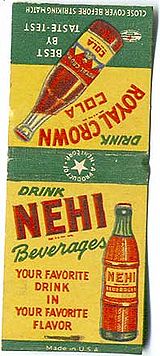
An advertisement for Nehi soda on a matchcover

History

The Chero-Cola company added Nehi Cola to its line of sodas in 1924 in order to offer a broader variety of flavors. It originally offered orange, grape, root beer, peach, and other flavors of soda. Nehi was instantly successful and outsold Chero-Cola entirely. The company changed its name to Nehi Corporation in 1928 and was listed on the New York Curb Exchange. Business went well until 1930 when a major crisis occurred. Reflecting the Great Depression, which followed with the stock market crash of October 1929, Nehi Corporation's sales figures dropped one million dollars in 1930 from a high of $3.7 million in the previous year. Sales continued to decline until 1932, the only year in which the company had ever lost money.

By 1933, the low point had been passed, and the business was just beginning to stabilize when another tragedy struck. Claude Hatcher, the company's president and guiding light from its formation, died suddenly December 31, 1933. Hatcher was soon replaced by H. R. Mott, vice president of the Nehi Corporation for several years beforehand, and who had been associated with the company since 1920. As new president, he was greeted with a great amount of debt. His all-consuming ambition, however, was to make the company debt-free as quickly as possible and to keep it that way. He updated operations, obtained extensions of credit, and cut expenses. Within a year, the Nehi Corporation was debt-free and ready to move ahead once more.

In the early 20th century, the advertising logo of Nehi was a picture of a seated woman's legs, in which the skirt was high enough to show the stockings up to the knee, suggesting the phrase "knee-high". This was referenced in Jean Shepherd's story "My Old Man and the Lascivious Special Award That Heralded the Birth of Pop Art" in the book In God We Trust, All Others Pay Cash, as well as in the film A Christmas Story, which was adapted from the book.

Robert Ripley helped the Nehi Corporation, when he advertised for them on his radio show "Ripley's Believe It or Not!" By 1940, Nehi products were available in forty-seven of the forty-eight states. In 1946, the pace for the Corporation accelerated tremendously. The company began to enhance its advertising by using celebrities. Bing Crosby, Joan Crawford (before joining the Pepsi Cola Company board of directors), Bob Hope, and many others joined in selling the products of Nehi Corporation. When World War II was over, the company and its bottlers joined whole-heartedly in a progressive program of expansion and improvement that made 1947 one of the great years in the history of the enterprise. In that year, glamorous Hedy Lamarr was pictured in point of purchase advertising signs. At that time, Nehi Corporation offered more than ten flavors. Those included Dr. Nehi, Nehi Chocolate, Nehi Root Beer, Nehi Lemonade, Nehi Wild Red, Nehi Blue Cream, and its more classic flavors Nehi Orange, Nehi Grape, and Nehi Peach. Many of these flavors were later dropped as their novelty and popularity waned.

Now, Nehi is very rare and can only be bought from a very few places.

On the television show M*A*S*H, grape Nehi was the favorite drink of company clerk Cpl. Walter "Radar" O'Reilly.


Nehi Strawberry

The fame of Nehi Cola lived on until the Nehi Corporation reformulated Chero-Cola, naming it Royal Crown Cola. "RC" Cola sold so well that the company changed its name to Royal Crown Cola Co. Internationally, Royal Crown rebranded the Nehi flavors as RCQ.

Source: Wikipedia

Roadside Diner's


A diner in Frazer, Pennsylvania

A diner, also spelled dinor in western Pennsylvania is a prefabricated restaurant building characteristic of North America, especially in the Midwest, in New York City, in Pennsylvania and in New Jersey, and in other areas of the Northeastern United States, although examples can be found throughout the US and in Canada. Some people apply the term not only to the prefabricated structures, but also to restaurants that serve cuisine similar to traditional diner cuisine even if they are located in more traditional types of buildings. Diners are characterized by offering a wide range of foods, mostly American, a casual atmosphere, a counter, and late operating hours. "Classic American Diners" are often characterized by an exterior layer of stainless steel—a feature unique to diner architecture.

History

The first diner was created in 1872, by a man named Walter Scott (Witzel). He worked at a printing press, and decided to sell food out of a horse-pulled wagon (Sawyer). He sold to night workers, and patrons of mens’ clubs. Scott then decided that his business was successful, he then quit his job and sold food full time ("American Diner Museum "). Scott’s diner can be considered the first diner with “walk up” windows that were located on each side of the wagon (Witzel).The first recorded diner was a horse-drawn wagon equipped to serve hot food to employees of the Providence Journal, in Providence, Rhode Island, in 1872. Walter Scott, who ran the lunch wagon, had previously supplemented his income by selling sandwiches and coffee to his fellow pressmen at the Journal from baskets he prepared at home. Commercial production of lunch wagons began in Worcester, Massachusetts, in 1887, by Thomas Buckley. Buckley was very successful and became known for his "White House Cafe" wagons. Charles Palmer received the first patent (1891) for the diner. He built his "fancy night cafes" and "night lunch wagons" in the Worcester area until 1901.

Worcester Lunch Car Company

In 1906 Philip Duprey and Irving Stoddard established the Worcester Lunch Car Company, which shipped 'diners' all over the Eastern Seaboard. The first manufactured lunch wagons with seating appeared throughout the Northeastern US in the late 19th century, serving busy downtown locations without the need to buy expensive real estate. It is generally accepted that the name "diner" as opposed to "lunch wagon" was not widely used before 1925. Many diners still exist in the Worcester area.


The Bendix Diner in Hasbrouck Heights, New Jersey, is an example of Art Deco style and neon signage.

Jerry O'Mahony Diner Company

A Bayonne, New Jersey, man by the name of Jerry O'Mahony is credited by some to have made the first "diner". The Jerry O'Mahony Diner Company of Elizabeth, New Jersey, produced 2,000 diners from 1917 to 1952. Only approximately twenty O'Mahony diners are still in existence throughout the United States and in certain parts of the world. In the U.S., the northernmost is Martha's Diner in Coventry, Vermont. The Summit Diner, a 1938 model, is located in Summit, NJ. The oldest southern diner (non–stainless steel style) is believed to be the Hillsville Diner in Carroll County, Virginia. The Triangle Diner, a 1948 stainless steel O'Mahony original model, is located in the old town of Winchester, Virginia and is currently being historically restored to how it appeared in 1948. The Triangle Diner is the oldest stainless steel style O'Mahony diner in the State of Virginia. In 2007 Tommy's Deluxe Diner was moved from Middletown, Rhode Island to Oakley, Utah where it opened as the Road Island Diner. One of the original ones displayed at the 1939 New York World's Fair, made by Paramount Diners, is still in operation as the White Mana in Jersey City.

Prefabricated Diners

As the number of seats increased, wagons gave way to pre-fabricated buildings made by many of the same manufacturers who had made the wagons. Like the lunch wagon, a diner allowed one to set up a food service business quickly using pre-assembled constructs and equipment.


Interior of the 1938 Sterling manufactured diner in Wellsboro, Pennsylvania - note curved ceiling

Until the Great Depression, most diner manufacturers and their customers were located in the Northeast. Diner manufacturing suffered with other industries in the Depression, though not as much as others, as people still had to eat, and the diner offered a less expensive way of getting into the restaurant business as well as less expensive food than more formal establishments. After World War II, as the economy returned to civilian production and the suburbs boomed, diners were an attractive small business opportunity. During this period, diners spread beyond their original urban and small town market to highway strips in the suburbs, even reaching the Midwest, with manufacturers such as Valentine.

Greek immigrants founded more than 600 diners in the New York region in the 1950's through the 1970's.

In many areas, diners were superseded in the 1970's by fast food restaurants, but in parts of New Jersey, New York, the New England states, Delaware and Pennsylvania the independently-owned diner remains relatively common. During this period, newly-constructed diners lost their narrow, stainless steel, streamlined appearance, and grew into much bigger buildings, though often still made of several pre-fabricated modules and assembled on site and still manufactured by the old line diner builders. A wide variety of architectural styles were now used for these later diners, including Cape Cod and Colonial. The old-style single module diners featuring a long counter and a few small booths sometimes now grew additional dining rooms, lavish wallpaper, fountains, crystal chandeliers and Greek statuary. The definition of the term diner began to blur as older, pre-fab diners received more conventional stick-built additions, sometimes leaving the original structure nearly unrecognizable as it was surrounded by new construction or a renovated facade. Businesses that called themselves diners but which were built onsite and not prefabricated began to appear. These larger establishments were sometimes known as diner-restaurants.

Architecture

Like a mobile home, the original style diner is narrow and elongated and allows roadway transportation. In the case of the diner, this is a carry-over from the first "true" diners ever built, which were never intended to remain stationary. The original diners (as opposed to "dining wagons") were actual dining cars on railways. When a dining car was no longer fit for service, it was often employed as a cheap restaurant at a (stationary) location near a train station or along the side of the railroad at some other location.


The Summit Diner in Summit, New Jersey, is a prototypical "rail car" style diner. Built by the O'Mahony Company in 1938.


A prefabricated diner in Salem, Massachusetts, still in use.

Later, tradition—along with equipment designed to build railcars—kept this size and shape. In this original floorplan, a service counter dominates the interior, with a preparation area against the back wall and floor-mounted stools for the customers in front. Larger models may have a row of booths against the front wall and at the ends. The decor varied over time. Diners of the 1920's–1940's feature Art Deco or Streamline Moderne elements or copy the appearance of rail dining cars (though very few are, in fact, refurbished rail cars). They featured porcelain enamel exteriors, some with the name written on the front, others with bands of enamel, others in flutes. Many had a "barrel vault" roofline. Tile floors were common. Diners of the 1950's tended to use stainless steel panels, porcelain enamel, glass blocks, terrazzo floors, Formica and neon sign trim.

Diners built recently generally have a different type of architecture; they are laid out more like restaurants, retaining some aspects of traditional diner architecture (stainless steel and Art Deco elements, usually) while discarding others (the small size, and emphasis on the counter).

Cultural Significance

Diners attract a wide spectrum of the local populations, and are generally small businesses. From the mid-Twentieth century onwards, they have been seen as quintessentially American, reflecting the perceived cultural diversity and egalitarian nature of the country at large.

In the days when diners were America's most widespread 24-hour public establishments, the fact that they were open all night meant they could also serve as symbols of loneliness and isolation. Edward Hopper's iconic 1942 painting Nighthawks depicts a diner and its occupants, late at night. The diner in the painting is based on a real location in Greenwich Village, but was chosen in part because diners were anonymous slices of Americana, meaning that the scene could have been taken from any city in the country-and also because a diner was a place to which isolated individuals, awake long after bedtime, would naturally be drawn. The spread of the diner meant that by 1942 it was possible for Hopper to cast this institution in a role for which, fifteen years earlier, he had used an Automat all-night restaurant.

But as a rule, diners were always symbols of American optimism. Norman Rockwell made his 1958 painting, The Runaway, generically American by placing his subjects, a young boy and a protective highway patrolman, at the counter of an anonymous diner. In television and cinema (e.g. The Blob, Happy Days, and Diner), diners and soda fountains have come to symbolize the period of prosperity and optimism in White America in the 1950s. They are shown as the place where teenagers meet after school and as an essential part of a date. The television show Alice used a "diner" as the setting for the program.

The diner's cultural influence continues today. Many non-prefab restaurants (including franchises like Denny's) have copied the look of 1950's diners for nostalgic appeal, while Waffle House uses an interior layout derived from the diner.


Manhattan was once known for its diners. The Moondance Diner, seen here, was shipped to Wyoming to make room for development.

Diners provide, in rather the same way that fast food chains do, a nationwide, recognizable, fairly uniform place to eat and assemble. The types of food served are likely to be consistent, especially within a region (exceptions being districts with large immigrant populations, in which diners and coffee shops will often cater their menus to those local cuisines), as are the prices charged. At the same time, diners have much more individuality than fast food chains; the structures, menus, and even owners and staff, while having a certain degree of similarity to each other, vary much more widely than the more rigidly standardized chain and franchise restaurants.

Diners frequently stay open 24 hours a day, especially in cities, making them an essential part of urban culture, alongside bars and nightclubs; these two segments of nighttime urban culture often find themselves intertwined, as many diners get a good deal of late-night business from persons departing drinking establishments. Many diners were historically placed near factories which operated 24 hours a day, with night shift workers providing a key part of the customer base.


Windward Park Way, Alpharetta, GA Retro-styled diner. Closed sometime around 2005.

The Poirier's Diner and Munson Diner, both manufactured by the Kullman Dining Car Company of Lebanon, New Jersey, are listed on the National Register of Historic Places.

American Diners Association

American Diners Association, founded in 1943, provides ample reviews for diners all around the world. They travel from diner to diner usually in packs of 35-40 to review various items on the menu. Chairman Soren Ibsen had this to say about the quality of diners; "I usually don't eat out, but when I do, I prefer a quality diner."

The ADA normally travels from 3-6am, exploring the various diners in a particular area. A supervisor who is on the bus typically calls the diner 30 minutes prior to arrival to ensure that the diner is prepared to seat 35-40 people

Cuisine and Ethnicity


Small diner in Brooklyn

The first diner was created in 1872, by a man named Walter Scott (Witzel). He worked at a printing press, and decided to sell food out of a horse-pulled wagon (Sawyer). He sold to night workers, and patrons of mens' clubs. Scott then decided that his business was successful, he then quit his job and sold food full time ("American Diner Museum"). Scott's diner can be considered the first diner with "walk up" windows that were located on each side of the wagon (Witzel). Diners almost invariably serve American food such as hamburgers, french fries, club sandwiches, and so on. Much of the food is grilled, as early diners were based around a grill. There is often an emphasis on breakfast foods such as eggs (including omelettes), waffles, pancakes, and French toast. Some diners serve these "breakfast foods" all day long. Many diners have transparent display cases in or behind the counter for the desserts. It is common with new diners to have the desserts displayed in rotating pie cases.

Like the British greasy spoon, the typical American diner serves mainly fried or grilled food, for example: fried eggs, bacon, hamburgers, hot dogs, hash browns, waffles, pancakes, omelettes, deep fried chicken, patty melts, and sausages. These are often accompanied by baked beans, french fries, cole slaw, or toast.

There is regional variation between diners. In Michigan and the Ohio Valley at "Coney Island–style" restaurants, coney dogs are served, as are certain types of Greek cuisine like gyros. In Indiana, fried pork tenderloin sandwiches are typically on the menu. The Northeast has more of a focus on seafood, with fried clams and fried shrimp commonly found in Maine. In Pennsylvania, cheesesteak sandwiches and scrapple are fixtures in most diners. Diners in the southwest serve tamales. In the southern U.S., typical dishes include grits, biscuits and gravy, and country fried steak. In New Jersey, the "Taylor Ham, Egg, and Cheese Sandwich" is a staple of many diners.


Serves breakfast and lunch. Owned by the Savannah College of Art & Design, and used as part of their culinary program. Diner originally operated in Newport, New Hampshire and was moved to current location in the late 1980s.

Coffee is ubiquitous, if not always of high quality. Many diners do not serve alcoholic drinks, although some may serve beer and inexpensive wine, while others—particularly in New Jersey and on Long Island—carry a full drink menu, including mixed drinks.

Typical desserts include a variety of pie, often on view in a transparent case. Most diners in New York also offer cheesecake.

The food is usually quite inexpensive, with a decent meal (sandwich, side dish, drink) available for one to one-and-a-half hours of minimum-wage income.

Several ethnic influences are strongly present in the diner industry. A large number of diners, especially in New Jersey, New York, Maryland, Pennsylvania, and Connecticut, are owned or operated by Greek Americans. Also, there a large number with Eastern European owners, chiefly Polish, Ukrainian, and Eastern European Jewish. Italian Americans also have a notable presence. These influences can be seen in certain frequent additions to diner menus, such as Greek moussaka, Slavic blintzes, and Jewish matzah ball soup.


The 1950's diner aesthetic is still in fashion for some more modern restaurants - here an example of the decor in a 2000's Burger King in Auckland, New Zealand.

Links:

AmericanDinerMuseum

Association of American Diners

Diner Capital: New Jersey's Diner Guidebook

RoadsideOnline's Diner Finder

Source: Wikipedia

Saturday, September 24, 2011

You Know You’re In Arkansas When .....


You visit the Arkansas State Fair mainly to see your neighbor's prize chicken.

You've been invited to or had a bunkin' party.

You carry jumper cables in your car.

You'd rather be Number One in football than Number One in education.

You think that recycling means riding your bike down the same old path.

Your school classes were canceled because of cold, heat, a tornado, hunting, or a livestock show.

Down South means Louisiana.

Your idea of a traffic jam is ten cars waitin' to pass a tractor on the highway.

You have no problem spelling or pronouncin' Ouachita or Possum Grape.

You've seen all the biggest bands…ten years after their last hit.

Your idea of a really great tenderloin is when the meat is twice as big as the bun and comes with cole slaw on top.

You say "catty-wampus" and "tumped over."

You see people wearing bib overalls at funerals.

You eat at Senor Tequila's for atmosphere and Lolita's Tex-Mex for salsa.

You say, "I voted for Clinton to get him out of the state."

You measure distance in minutes.

You know the difference between a deer dog, a duck dog and a coon dog by the way they bark.

You know a bunch of people who have hit a deer.

You or your neighbors have more hunting dogs than you have family members.

Goin' on "vacation" means headin' through Harrison on the way to Branson.

You've never met any celebrities.

You know a few that have also hit a coyote.

You know what a "cow drop" is.

You have your own secret bbq sauce.

You put security lights on your house and your garage and leave both of them unlocked.

You've seen the Boggy Creek Monster, or it has at least taken your chickens, cattle, dogs or livestock.

Pulaski County is considered a foreign or exotic place.

You know what Toad Suck and Booger Holler are.

You consider being a "Beef Queen" an honor.

You know how to snipe hunt.

You faithfully drink Pepsi, Mt. Dew, or Dr. Pepper everyday of your life.

When asked how your trip to any foreign, exotic place was you say, "It was different."

Stores don't have bags or carts…they have sacks and buggies.

You think orange barrels are really part of the interstate system.

Your traditional Thanksgiving dinner is a deep-fried turkey.

You see "No Hunting" signs are riddled with bullet holes.

You've ridden the school bus for an hour…each way.

You think "Animal House" is the training film for incoming athletes at the University of Arkansas.

Everyone you think of as a "liberal" is either Methodist or Catholic.

You've ever had to switch from "Heat" to "A/C" in the same day.

You've "offered" someone an "a@$-whoopin'."

You end your sentences with a preposition, for example, "Where's my coat at?"…. "What's that made out of?"

The three food groups are Velveeta, pork rinds and a six-pack.

All the festivals around the state are named after a fruit, vegetable, bricks, or lumber.

When you give directions they include "over yonder," "down the road a piece," and "right near."

You drink sweet iced tea out of a sports bottle.

You think ethanol makes your truck run a lot better.

You're not commitment-phobic: you love God, guns and football.

Priming was your first job…and you know what it means.

You think pinto beans are nekkid without hamhocks, cornbread and buttermilk.

When the forecast calls for an inch of snow, you run out with all the other crazies to stand in line for three hours to buy a month's worth of groceries.

Sweet milk and torn up biscuits in a glass is your favorite dessert.

You see a car running in the parking lot at the store with no one in it no matter what time of the year.

You think bagels are nothing but a cruel doughnut joke invented by some Yankee!

You own three cars and one license plate.

You actually get these jokes and pass them on to other friends from Arkansas.

Source: Internet

Twisted Facts

On average, 100 people choke to death on ballpoint pens every year.

Butterflies taste with their feet.

More people are killed by donkeys annually than are killed in plane crashes.

In 1994, electromagnetic interference (EMI) from a nearby cellular telephone captivated the power of a wheelchair at a scenic vista in Colorado, sending the passenger over a cliff.

More people working in advertising died on the job in 1996 than those who died while working in petroleum refining.

Babies are born without knee caps. They don't appear until the child reaches 2-6 years of age.

A cockroach will live nine days without its head, before it starves to death.

On average people fear spiders more than they do death.

Thirty-five percent of the people who use personal ads for dating are already married.

Elephants are the only mammals that can't jump.

Only one person in two billion will live to be 116 or older.

It's possible to lead a cow upstairs...but not downstairs.

Women blink nearly twice as much as men.

The Main Library at Indiana University sinks over an inch every year because when it was built, engineers failed to take into account the weight of all the books that would occupy the building.

Four sunken nuclear submarines sit at the bottom of the Atlantic Ocean. One, a Russian sub resting in deep water off of Bermuda, holds 16 live nuclear warheads. Scientists and oceanographers are unsure what the impact of the escaping plutonium will have, but warn that corrosion could create the proper chemical environment for a massive nuclear chain reaction.

The electric chair was invented by a dentist.

All polar bears are left handed..

An ostrich's eye is bigger than its brain.

TYPEWRITER is the longest word that can be made using the letters only on one row of the keyboard.

"Go." is the shortest complete sentence in the English language.

A crocodile cannot stick its tongue out.

In the 1890's more than 30 people were axed, hanged, burned and mobbed to death in the United States for practicing witchcraft.

The average human eats eight spiders in their lifetime at night.

Unusual deaths have plagued the cast of the Poltergeist trilogy of films including 12-year-old actress Heather O'Rourke, who died of septic shock. The theory is that the set was cursed by evil.

A dragonfly has a lifespan of 24 hours.

Cat's urine glows under a black light.

In 1970, a group of people were arrested at Highgate cemetery for intent to harm...a vampire! The vampire is rumored to still be around today.

Prisoners in a California jail were so spooked by a Ouija board they made that Priests were called in to cast out the demons. The convicts had summoned up spirits, including a woman who told them how she was murdered.

The human heart creates enough pressure when it pumps out to the body to squirt blood 30 feet.

On average, people fear spiders more than they do death.

The strongest muscle in the body is the tongue.

After complaining about the smell in their room, a couple staying in a hotel in the United States discovered the body of a murdered girl under their bed.

It's impossible to sneeze with your eyes open.

Ants always fall over on their right side when intoxicated.

The catfish has over 27,000 taste buds, that makes the catfish rank #1 for animal having the most taste buds.

Starfish haven't got brains.

Rubber bands last longer when refrigerated.

Peanuts are one of the ingredients of dynamite.

The average secretary's left hand does 56% of the typing.

There are more chickens than people in the world.

No word in the English language rhymes with month, orange, silver or purple.

In most advertisements, including newspapers, the time displayed on a watch is 10:10.

In England, the Speaker of the House is not allowed to speak.

The name for Oz in the "Wizard of Oz" was thought up when the creator, Frank Baum, looked at his filing cabinet and saw A-N and O-Z, hence "Oz."

The microwave was invented after a researcher walked by a radar tube and a chocolate bar melted in his pocket.

It is physically impossible for pigs to look up into the sky.

A pregnant goldfish is called a twit.

More than 50% of the people in the world have never made or received a telephone call.

Nearly a third of all bottled drinking water purchased in the US is contaminated with bacteria.

Homely criminals get 50% longer jail sentences, on average, than good-looking criminals.

Wearing headphones for just an hour will increase the bacteria in your ear by 700 times.

If the government has no knowledge of aliens, then why does Title 14, Section 1211 of the Code of Federal Regulations, implemented on July 16, 1969, make it illegal for U.S. citizens to have any contact with extraterrestrials or their vehicles?

In every episode of Seinfeld there is a Superman somewhere.

A shrimp's heart is in its head.

In a study of 200,000 ostriches over a period of 80 years, no one reported a single case where an ostrich buried its head in the sand.

February 1865 is the only month in recorded history not to have a full moon.

Donald Duck comics were once banned in Finland because he doesn't wear pants.

If you keep a Goldfish in the dark room, it will eventually turn white.

A snail can sleep for three years.

Average life span of a major league baseball: 7 pitches.

Our eyes are always the same size from birth, but our nose and ears never stop growing.

The shortest war in history was between Zanzibar and England in 1896. Zanzibar surrendered after 38 minutes.

A polar bear's skin is black. Its fur is not white, but actually clear.

Almonds are members of the peach family.

Tigers have striped skin, not just striped fur.

A duck's quack doesn't echo and no one knows why.

In 10 minutes, a hurricane releases more energy than all the world's nuclear weapons combined.

Horses and rats can't vomit.

Accidental deaths caused by Physicians in per year are 120,000.

The termites of the world outweigh humans 10:1 !!!

It is impossible to lick your elbow.

The legend of Loch Ness in Scotland is 1,500 years old. The last reported sighting was in 1998, when it was filmed swimming across the loch

A goldfish has a memory span of three seconds.

A rhinoceros horn is made of compacted hair.

In 1975 a Bedfordshire family were shocked when a huge chunk of ice fell from the sky, straight through their roof. No explanation has ever been found...

The Amityville films of the 70's, about a house full of ghostly activity were based on a true story.

Nutmeg is extremely poisonous if injected intravenously.

In 1982, a Chicago woman who was walking down the street burst into flames for no apparent reason.

If you yelled for 8 years, 7 months and 6 days, you would have produced enough sound energy to heat one cup of coffee. If you fart consistently for 6 years and 9 months, enough gas is produced to create the energy of an atomic bomb.

Americans on average eat 18 acres of pizza every day.

A young girl in America bet her friends she could spend the night in a cemetery. They found her in the morning dead in the arms of a statue.

If the population of China walked past you in single file, the line would never end because of the rate of reproduction.

Over 75% of people who read this will try to lick their elbow.

Source: Internet

Carnival Memphis

Carnival Memphis (formerly known as the Memphis Cotton Carnival), is a series of parties and festivities staged annually since 1931 in Memphis, Tennessee by the centralized Carnival Memphis Association and its member krewes (similar to that of Mardi Gras) during the month of June. Carnival salutes various aspects of Memphis and its industries, and is reigned over by the current year's secretly selected King, Queen, and Royal Court of Carnival.

Royalty

The Royal Court is made up of young women from Memphis (princesses), mostly around the age of nineteen, typically having completed their first-year of study in college, and their escorts. Members of the Court not from the city of Memphis are known as "Ladies of the Realm." Members of the Court sometimes carry special titles such as the "King's Princess," in which she is selected by the King himself to bear this title, as is a "Queen's Princess," a "President's Princess", and princesses representing various social clubs in Memphis, such as the "Princess of the Memphis Country Club" or the various krewes within Carnival. The male escort of the princess representing the various social clubs normally bears the masculine form of the title as well, making one in this instance be the "Prince of the University Club." The Queen is a young woman who is at least a few years older than the court, typically being the age one would be having finished two to three years in college. The King is traditionally much older than the court, and is a prominent leader from the current year's saluted industry. “Carnival” is usually held during the first week of June, commencing the Friday after Memorial Day, beginning with the Crown & Sceptre Ball and ending with the Grand Carnival Ball. During this time the Grand Krewes of Carnival also hold their own events and parties celebrating their King, Queen and Court, along with the entire revelers of Carnival Memphis.

Governance & Krewe System

Carnival Memphis is put on by the Carnival Memphis Association, which is governed by a Board of Directors, (vacancies are filled by the other members of the Board), a President (elected annually by the Board members), and an Executive Director, who manages the daily aspects of the association.

The Carnival Memphis Association organizes, plans, budgets, and promotes the King, Queen, and Royal Court, as well as many of the events staged during Carnival week. However, the Grand Krewes (once known as secret societies) also stage their own festivities throughout the year, elect their own royalty, manage their own budget, and have their own membership requirements. Most of these organizations bear Egyptian names in accordance to tradition originally set out by the Mystic Memphi, and in conjunction with Memphis being the sister city of ancient Memphis, Egypt. The twelve Grand Krewes that Carnival Memphis recognizes are the Mystic Society of the Memphi, Osiris, Sphinx, RaMet, Ennead, Phoenix, Aani, Ptolemy, Kemet Jubilee, Ptah, Luxor, Queen Bees. The Secret Order of the Boll Weevils is a support group of Carnival that is not a Grand Krewe. The Grand Krewes of Memphi, Osiris, RaMet and Sphinx are “old-line” Grand Krewes and were all started in the 1930’s as the original secret societies of the Memphis Cotton Carnival. However, Memphi considers its history traceable to the 1870’s as the original promoters of the Memphis Mardi Gras, although it became defunct during the time that span between the last Mardi Gras and its restoration as a Cotton Carnival secret society. Membership requirements and financial commitments are normally more complex when one wishes to join one of the older krewes, as compared to the newer krewes, that may have little or no membership process. Memphi and Osiris are all-male organizations, with some exceptions. Memphi allows their past queens to become members after their reign, following their belief that “once a Queen, always a Queen!.”

Each Grand Krewe is independently governed by a Board of Directors, and elects its own executive from within its membership. The title of the executives differ from krewe to krewe, mostly known as “General Chairman,” or “Chairman”. The King and Queen of Carnival Memphis are kept secret until an announcement usually in early February. A few of the old-line Grand Krewes keep their royalty a secret throughout most, if not all of Carnival. The Sublime Ouro (the King) of Memphi is not announced until the Wednesday night of Carnival Week to his own krewe members. The King of Osiris is announced on the last day of Carnival Week.

History

Mardi Gras Era

In 1872, Memphis as much of the South, was suffering from the devastation of the Civil War and Reconstruction. The city fathers thought that Memphis needed some show of civic pride that would bring the residents together for a common good and demonstrate to the outside world that the city was alive and well. They decided on a Mardi Gras celebration to help re-invigorate the spirits of the population. The city of Memphis celebrated Mardi Gras, and a Carnival season based on the traditional Christian liturgical calendar just before the season of Lent, similar to what is still practiced in cities such as New Orleans, Louisiana, Mobile, Alabama, Galveston, Texas, Venice, Italy and Rio de Janeiro, Brazil. This was largely staged by secret societies, or a “krewe” system, but mostly through the efforts of the Mystic Society of the Memphi. The societies held massive parades, elaborate balls and parties, to celebrate during this festive season. However, Memphis experienced the devastation of a yellow fever epidemic which along with cholera wiped out much of the city's population. Mardi Gras celebrations in Memphis slowly ceased to exist, and by the late 1890's, the Mystic Memphi and other societies, as well as the Mardi Gras festivals as a whole were no longer an active institution in the city.

The Memphis Cotton Carnival is Born

During the early twentieth century, great interest developed in creating a city-wide event like Carnival, and re-establishing the Mystic Memphi. As more and more influential Memphians became actively interested, Memphi and the Memphis Cotton Carnival Association were established in the early 1930’s. The efforts were conducted to bring a sense of excitement and life back to the city of Memphis and its people. However, rather than following the Lenten calendar and being held strictly to celebrate Mardi Gras, designers decided that this festival would promote something else, Memphis' primary asset at the time-cotton. During this time, Memphis and the Mid-South region, like the rest of the United States, were in the throes of the Great Depression. Many were out of work and the region's cotton, was selling for pennies a pound. The prosperity of the Mid-South was dependent on cotton and measures had to be taken to increase the use of this precious commodity. At the same time, the Memphis Chamber of Commerce was having trouble raising money to compete with other cities in the South, such as Atlanta and New Orleans. A. Arthur Halle and a group of businessmen called on Herbert Jennings, a downtown theatre manager for a donation. Jennings agreed to contribute and shared an idea that he believed would help promote business and draw attention to cotton. To help publicize an upcoming movie, Jennings offered local retailers the opportunity to display cotton goods in his theatre and planned to encourage them to use their own store windows to promote cotton clothing. Halle was intrigued by the idea and envisioned a larger city-wide promotion and called upon Everett R. Cook, who was President of the Memphis Cotton Exchange at this time. Cook was invited to come to the theatre to hear the ideas. Those ideas quickly grew into a plan for a grand celebration with a King, Queen and Royal Court that would involve people from all over the Mid-South. The idea was to promote the use and wearing of cotton products which would lead to increased demand and stimulate sales. It worked, as people began to demand more cotton products from socks to ball gowns and the rest as they say, is history.

Cook expressed his vision this way: "Carnival is to promote business for everybody and should not be used by any one group. It is for all of the stores and all of the people, for all kinds of professions and businesses, for the city as a whole regardless of the size of the business, the social standing, wealth, prestige, family background or anything else that would tend to make anyone feel that he or she would not be invited to participate in Carnival."

The fanfare and excitement that centered around the Cotton Carnival climaxed throughout the mid-to-late twentieth century. During this time, the event stretched several weeks during the months of May and June, and had incorporated much more than it had originally set out to do. The Memphis Cotton Carnival Association had become a very centralized governing body, which along with the participating krewes, was becoming a festival that could not be rivaled anywhere in the South except New Orleans' Mardi Gras (in which it brought in as many numbers). While the series of street parades in downtown Memphis continued to be held, in addition to the numerous parties at many of the city’s most elite social clubs continued, the event started to form a new face of entertainment that dubbed it the “South’s Greatest Party” for all to enjoy. The Carnival and its krewes held on to the traditional aspects of Carnival, but entertained onlookers with such musicians as Elvis Presley, Waylon Jennings, and Jerry Lee Lewis, welcoming guests from all over the United States, and from all over the world. By this time it had truly become the city's most important and celebrated event, participated by Memphians and Mid-Southerners from all socioeconomic backgrounds. In addition to the Music Festival, its most intriguing and popular event was the Arrival of the Royal Barge. This event was very much a “sight to see” in which the King, Queen, and Royal Court, along with the royal pages, guards, and other participants would all ride in on a beautifully decorated barge on the Mississippi River, docking in downtown Memphis for all onlookers to revel and awe over. With elaborately designed and well-lit backdrops, along with the night sky being lit up with an array of fireworks, this was truly a wonder for everyone present. The entire city, it seemed, gathered along the Mississippi riverbanks on a spring evening to attend the Royal Barge Landing, walk along the Carnival midway, and watch the Carnival parade. Many national publications and media covered the fanfare, and the Association even crowned a Maid of Cotton to tour the globe and promote cotton fashions.

Decline

The assassination of Dr. Martin Luther King, Jr. left Memphis devastated in many different ways, one aspect being the state of its downtown. As urban sprawl began to be more and more common, with businesses and residents moving away from the city’s inner core, the public events that were once staged by the Cotton Carnival became few and far between. Parades slowly became a thing of the past, as did the arrival of the Royal Barge. The city of Memphis municipal government acquired the “float factory” once used to manufacture the elaborately decorated floats, and mainstream Memphians and Mid-Southerners grew less and less interested in staging this event. Also, other festivals began to form that took the place of Carnival, such as the Memphis in May International Festival, and its highly anticipated Beale Street Music Festival.

Over the years, however, Carnival’s luster began to fade along with the declining role of cotton in the area. The national press gradually lost interest, and the Maid of Cotton Pageant was moved to Dallas, Texas, where it exists today. For various reasons, the 1980’s saw the name of the Cotton Carnival be changed to the Great River Carnival, and because of even less approval changed again to Carnival Memphis. The organization sited this was done because the community had grown in such tremendous ways, and that the Memphis economy had become more diversified and no longer centered exclusively around cotton. The king was beginning to be chosen from leaders in other aspects of commerce other than the cotton industry, and was no longer referred to as “King Cotton,” but as simply King, or Rex Carnivali.

For years, the Cotton Carnival was, though not officially, for all intents and purposes for whites only. When a Beale Street dentist named Dr. R.Q. Venson took his nephew downtown to see a Carnival parade in 1934, complete with the marching bands and floats (which were for a few years in its existence pulled by black men), and asked him how he liked it. He didn’t, his nephew replied, because "all the negroes were horses." Venson enjoined other black Memphians to hold their own separate event. As a result, the Cotton Makers' Fiesta was organized in 1934. The name changed to Cotton Makers' Jubilee and, as a protest to establish dignity and respect for Negro men and women, the first celebration was held the third week of May 1936. The Jubilee enjoyed its most successful years from 1948 to 1958. There were only two occasions in the celebrations past when no activities took place. The first such time was during the World War II and the second occasion in 1968 due to the assassination of Dr. Martin Luther King, Jr. The organization briefly merged with Carnival Memphis in 1982 when it became known as the krewe Kemet Jubilee.

The King was, and still is, an older man who had ties with the industry being saluted that year, while the Queen was, and still is, a young, unmarried woman from one of Memphis’ "better" families. That’s one tradition, at least, that hasn’t changed over the years.

The elitist charge came about from all the supposedly secret activities of the Carnival royalty and especially the various Grand Krewes, whose membership — and parties, especially — were by invitation only. Year after year, many outsiders would read The Commercial Appeal (Memphis newspaper) stories of fancy-dress balls and dinners and dances held by mysterious-sounding, Egyptian-themed Krewes, and wonder, why they could not attend those parties or have their daughters debut in these certain circles; this sense of separation within the Memphis community led to charges of elitism.

Carnival Memphis Today

By the later twentieth century Carnival Memphis had the general reputation of having dwindled down to nothing but a series of formal debutante parties at the various private social and country clubs, consisting largely of the city’s elite gathering together to promote an event that “was once, but no longer”, and it was truly living out its twilight years. Gone were the parades, the grand parties, the fireworks, the midway, and the hustle and bustle of an entire metropolitan area to promote itself and to gather together to take part in such a great event.

However, as Carnival officials grew more and more aware about certain negative issues surrounding the event and its severely declining reputation, they began actually implementing steps over the years to bring outsiders into their realm. More and more Carnival events are now open to the public. African-American Memphians are beginning to take part, and Carnival had one black Krewe, Cotton Makers' (currently Kemet) Jubilee, from 1982-2007. Also, Carnival has begun selecting local charities and organizing special events just for Carnival krewes, with each charity receiving a monetary donation.

Seventy-four years later, the mission of Carnival remains much the same as it was in 1931-to recognize and promote an industry that has a major economic impact on the Mid-South community, and to promote the City of Memphis as a great place to live and work, and to cause an annual celebration in honor of that industry and the people of the Mid-South. The general motto of Carnival Memphis is “Convivium Cum Propositione,” Latin for “The Party with a Purpose!”.

Links:

Carnival Memphis Association website:

Mystic Society of the Memphi website

Grand Krewe of PTAH website

Grand Krewe of Ptolemy website

Grand Krewe of RaMet website

Source: Wikipedia