See Rock City

See Rock City

Tuesday, January 10, 2017

They Thought She Was Cute And Harmless. But Never Judge A Book By Its Cover!

What do you think a 9 year old girl would want to do when she grows up? Stereotypes tell us she would want to be a ballerina or maybe a veterinarian. But things are changing for the best. Stereotypes are changing, and Jesse Jane McParland is most definitely NOT your stereotypical 9 year old girl.

When Jesse was very young, her parents wanted her to take classes like many young girls do. They tried taking her to ballet classes but, right away she was having none of it, she hated it.

After looking around for a while she decided to try martial arts instead. And oh boy, this was definitely the right path for her. She picked it up in no time and she became incredible at it.

In very little time began to master these new skills and within some short years she decided to try and show off her skills at Britain’s Got Talent. Her audition is the video you are about to see. When she first started it almost seemed as though the judges almost dismissed her. She is so small and cute that it’s hard for most people to take her seriously as a martial artist. But as soon as she started her routine, the judge’s jaws dropped. You have to see this audition to believe it. To make this story even more incredible, shortly after her audition she got cast for a part in a new movie called “The Martial Arts Kid” featuring the famous actor, Zac Efron.

Watch the video below and don’t forget to share with your family and friends!


Source: metaspoon.com


Tuesday, January 3, 2017

Are Living Conditions Getting Better Or Worse?


There is no doubt about the fact that global conditions are changing, but are they changing for the better, or for the worse? "All things considered, do you think the world is getting better or worse, or neither getting better nor worse?" was a question asked by a recent survey. In Sweden, 10% thought that things are getting better, in the US this dropped down to 6%, and in Germany this decreased even further to 4%. In other words, not a lot of people think that the world is getting better.

So, what evidence do we need to consider when trying to answer this question? Well, the question is about how the world has changed and, therefore, we need to look at it from a historical perspective. Furthermore, the question is about the world so the answer has got to consider everyone - the answer must take into account the history of global living conditions; the history of everybody.
Below we take a look at how poverty, literacy, health, freedom, and education have changed over the last two centuries.

1. Poverty

To properly see where we are coming from it is imperative that we take a trip far back in time - 30, 40, 50, 60 years is not enough. The reason for this is that if you only consider what the world has looked like during our lives, it is all too easy to make the serious mistake of thinking  that the world is static - the rich, educated and healthy parts of the world are here while the poor, uneducated and unhealthy parts are over there.  To do this, you're falsely concluding that it has and always will be like that.
Go back to a time before our lifetime, and it becomes crystal clear that the world is not static. Rich countries today were very poor in the past and were in fact a lot worse off than the poor countries of today's world.  In fact, to avoid looking at the world in a static way we have to go back 200 years before the period when living conditions changed dramatically.
Poverty, according to researchers, is living with less than $1.90 per day. This figure takes into account non-monetary forms of income and is adjusted for different price levels in different countries and inflation.
The chart below shows the figures for the world population living in extreme poverty from the 1820s onwards. As you can see, in 1820, only a small percentage had high standards of living, while nearly everyone else lived in conditions that would be considered as extreme poverty today. Since then, the percentage of extremely poor people has decreased continuously.  For example, in 1950, 75% of the world was living in extreme poverty; in 1981 it dropped to 44%. Latest research suggests that extreme poverty is now below 10%.
This is pretty impressive considering that the world's population has dramatically increased over the last two centuries. You would have thought that such a population increase would lead to more extreme poverty, but the fact of the matter is that the opposite has happened. In a time of continuous population growth, our world has managed to give prosperity to more people and lift them out of extreme poverty.

2. Literacy 

The chart below shows the percentage of the world's population that has been literate over the last 200 years. As you can see, only a tiny elite were able to read and write at the beginning of the 19th century. In fact, in 1820, only 1 person in 10 was literate; in 1930 it was every 1 in 3 and now 85% of the world is literate.  Put in a different way, if you were living in 1800 there would be a 9 in 10 chance that you couldn't read - today, more than 8 out of 10 people are literate.

3. Health 

One reason why we might not see progress is because we just aren't aware of how bad the past was. we must take a look at the past in order to see just how much progress we have truly made.
In 1800, the living conditions of our ancestors were so bad that 43% of the world's newborns died before they turned 5. In other words, all over the world, more than every third child died before they reached their 5th birthday.
Nowadays, the child mortality rate is down to 4.3% - 100 times lower than 2 centuries ago. This is thanks to a vast improvement in modern medicine, science, housing, sanitation and diets (made possible through an increase in agricultural productivity and oversea trade). 
 
4. Freedom

In order to get a time perspective of how political freedom has changed over the last two centuries, we can take a look at the chart below which shows the percentage of people living under different types of political regimes.
As you can see, throughout the 19th century, more than a third of the world's population lived under colonial regimes and everyone else lived under autocratic rule. The first expansion of political freedom (from the late 19th up until the time of World War II) was crushed by the rise of authoritarian regimes. However, during the second half of the 20th century, the world has changed dramatically; the Colonial Empires ended, and more and more countries started to turn towards democracy. Now, every second person in the world lives under democratic rule.

5. Education

None of the human race's achievements over the last two centuries would have been achieved without the expansion of education and knowledge.
We can be pretty certain that education is on track to continue improving globally. The reason we can make such a prediction is that the educational composition of today tells us a lot about the education of tomorrow - a literate young boy today will still be a literate man in 2060 and a student with a university degree  now will still be a student with a university degree in the future.
The final chart below shows the projection of the IIASA Institute for the total world population by level of education until 2100. As can be seen, the chart suggests that by 2100, there will  be only a very small percentage of people without formal education, and there will be more than 7 billion people with at least secondary education.

Conclusion

The only possible way to tell the history of everyone is by using statistics, because only then can we get a realistic overview of the global living conditions of the 22 billion people that have lived over the past 200 years. The aforementioned survey shows that people believe that the world is getting worse, but, as the charts have proven, this is clearly not the case.  Overall, the statistics reveal that our global living conditions are improving - slowly, but surely.  

Source:  ba-bamail.com

Monday, January 2, 2017

In 1912 Henry Ford And Edison Came Together To Conceive A Low-Priced Electric Car


Back in 1896, Henry Ford attended the convention of the Association of Edison Illuminating Companies, held at the Oriental Hotel on Manhattan Beach in Brooklyn, New York.
This is where he met his boyhood hero, Thomas Edison. Henry Ford worked as an engineer with the Edison Illuminating Company from 1891 to 1899 but he never had the chance to met him in person until 1896. Later they became good friends.
They camped together, and they even owned houses immediately adjacent to each other.
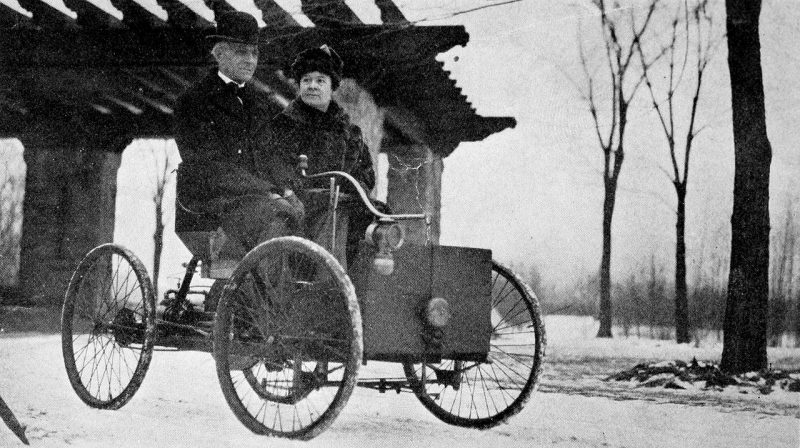
In 1896 when Henry Ford for the first time drove his Quadricycle on the streets of Detroit, he worked for Edison at Detroit Edison Illuminating Company. A few months later, when they finally met, Edison  encouraged Ford to pursue his plans for a gasoline automobile.
Mr. and Mrs. Henry Ford in his first car, the Ford Quadricycle
Later Edison and Ford decided to put their minds together to conceive a low-priced electric car. In fact, Edison held a number of patents related to the electric vehicle, including Electric Generator or Motor (1884), a Means for Propelling Electric Cars (1891), a Reversible Galvanic Battery (1900), an Electrode for Batteries (1901), an Alkaline Battery (1904), and an Electrical System for Automobiles (1912).
At that time Ford founded his eponymous automobile company. The only problem that they were facing was to invent the longest lasting battery in the world. As we mention it before Edison had already invented the alkaline storage battery in 1901 and he spent many years perfecting it before placing it in the 1912 Edison electric car.
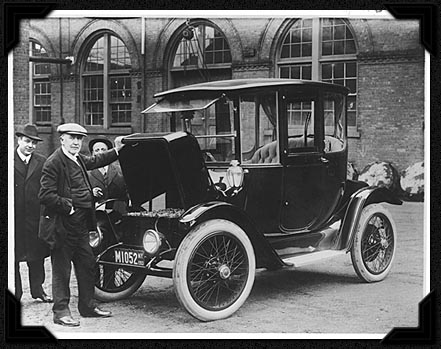
Thomas Edison and an electric car in 1913
The downside of the Edison battery was the cost, which led to the dominance of the inferior lead acid battery still in common use today and eventually to the development of several other nickel battery chemistries.  Nonetheless, the Edison battery became Thomas Edison’s most profitable invention, gaining wide adoption in mining lamps and railway signaling.
Edison managed to build three cars, one of which he drove from Scotland to London, charging it up along the way. The inventor had said that electricity was the future since “all the oil would be pumped out of the ground.” His electric car with two 15-volt batteries and a 30-volt electric motor could reach speeds of 25 miles per hour, which is impressive for the time.
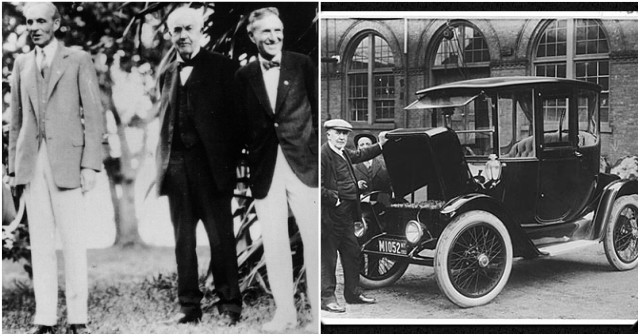
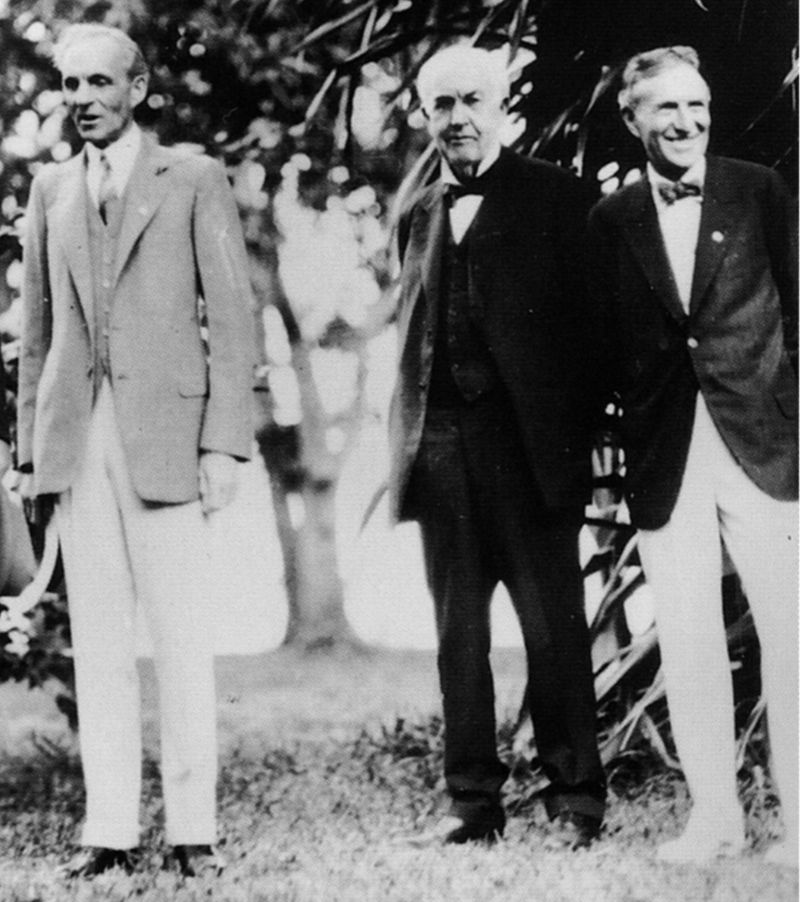
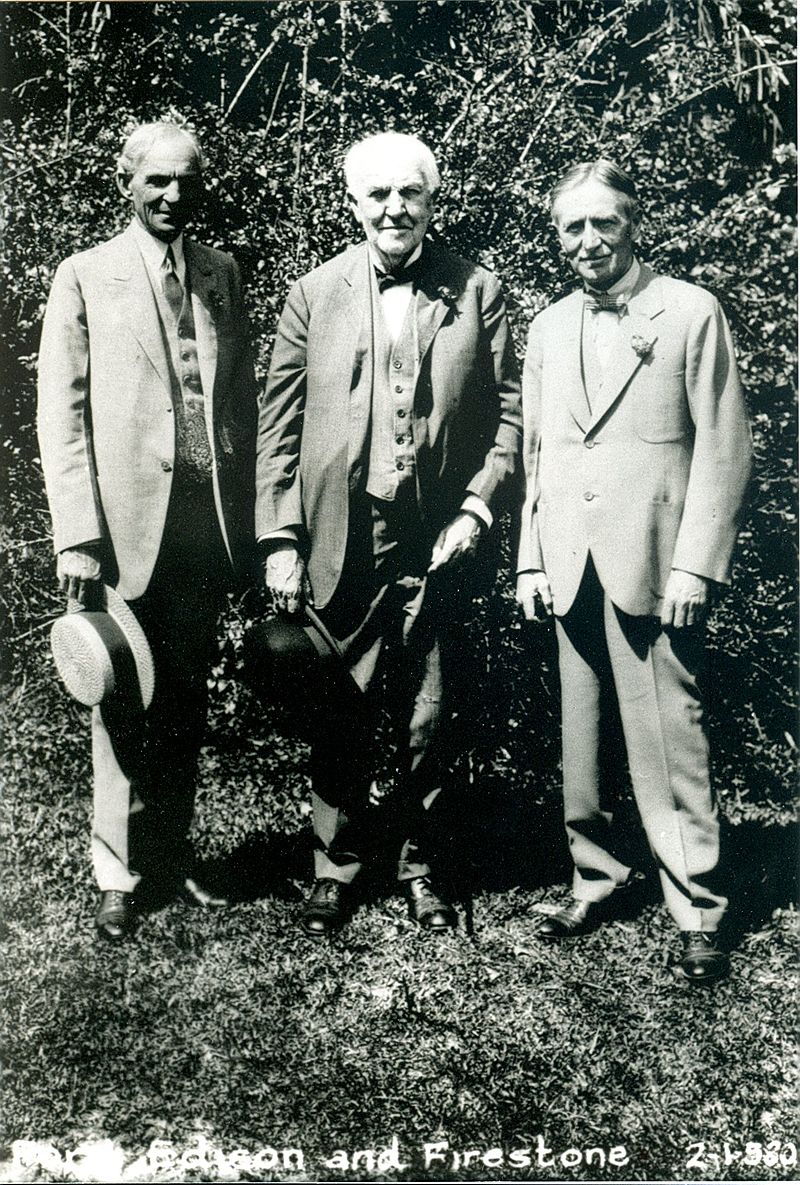
Henry Ford with Thomas Edison and Harvey Firestone
In early 1914 Henry Ford started working on a low-priced electric car. On January 11, 1914, issue of the New York Times, Ford confirmed that he was working on electric car:
“Within a year, I hope, we shall begin the manufacture of an electric automobile. I don’t like to talk about things which are a year ahead, but I am willing to tell you something of my plans.
The fact is that Mr. Edison and I have been working for some years on an electric automobile which would be cheap and practicable. Cars have been built for experimental purposes, and we are satisfied now that the way is clear to success. The problem so far has been to build a storage battery of light weight which would operate for long distances without recharging. Mr. Edison has been experimenting with such a battery for some time.” 
From Left to Right: Henry Ford, Thomas Edison, and Harvey Firestone. Photo Credit
The Edison-Ford car would cost between $500 and $750, and it would range somewhere between 50 miles and 100 miles on a charge. But it wasn’t easy to design and construct the car and in an interview with Automobile Topics in May 1914 Edison said:
“Mr. Henry Ford is making plans for the tools, special machinery, factory buildings and equipment for the production of this new electric. There is so much special work to be done that no date can be fixed now as to when the new electric can be put on the market. But Mr. Ford is working steadily on the details, and he knows his business so it will not be long.” 
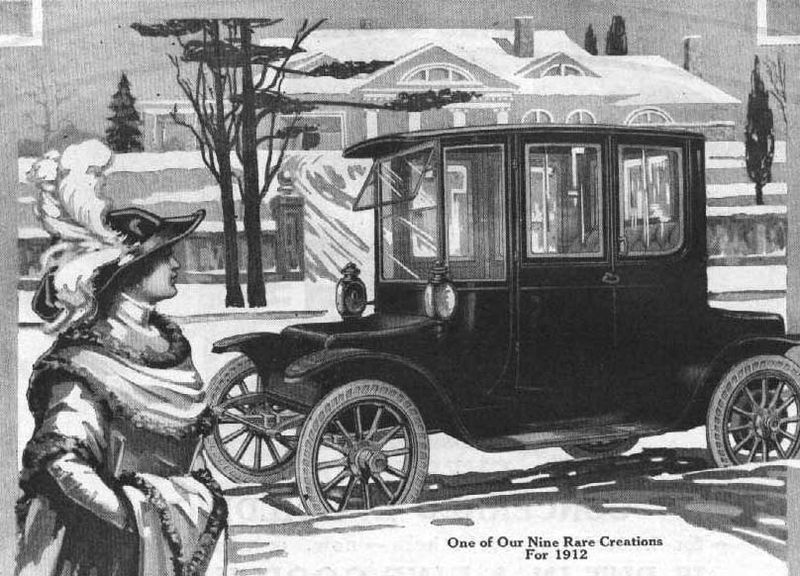
1912 Detroit Electric advertisement.
It’s believed that the oil cartels got to Ford and Edison and caused them to abandon the project. Edison’s workshops in West Orange was destroyed by fire in December 1914 and the project fell apart.

We wonder what the pair would have thought about the electric cars of today?!

Source: thevintagenewa.com

Brother Jordan (Jourdon) Anderson


Freed slave wrote sarcastic letter to his former master after he asked him to come back to his plantation. 

Jordan Anderson was born around 1825 somewhere in Tennessee. When he was around 7-years-old he was sold as a slave to General Paulding Anderson.
He was a personal servant and also a playmate of general’s son Patrick Henry Anderson since they were both around the same age.
As years passed by he became one of the most reliable and able workers on the Anderson family plantation in Big Spring, Tennessee.
He married Amanda McGregor in 1848 and in 1864 and they would eventually have eleven children together, after 32 long years in the service of his master, Jordan Anderson and his wife, Amanda, escaped a life of slavery when Union Army soldiers freed them from the plantation.
Image of freed slave: Jordan Anderson
When his freedom was granted he left the plantation immediately. His master Patrick Henry Anderson was so angry that Jordan was leaving the plantation that he tried to shoot him, but a neighbor managed to grab Patrick’s pistol from him. He vowed to kill Jordan if he ever set foot on his property again.
Jordan started working in a hospital where he became close friends with a surgeon called Dr. Clarke McDermont. In 1865 when the Civil War ended, Dr. Clarke McDermont helped Jordan and his family move to Dayton, Ohio where his father-in-law, Valentine Winters, was living and could help Jordan to secure work in the town.
Jordan was living a quiet life with his large family but in July of 1865, he received an urgent letter from his former master. Since he couldn’t read he took the letter to Valentine Winters and asked him to read it to him.
As it was written in the letter the Anderson’s plantation had fallen into complete disrepair and Anderson found that he could not keep up his holdings after losing his captive labor force so he decided to ask help from Jordan.
Apparently, Jordan’s former master was in total financial ruin.  He promised that Jordan would be paid and be treated as a free man if he returned.
Newspaper print of Jordan Anderson's letter
Newspaper print of Jordan Anderson’s letter
After few days Jordan decided to write back to his former master. You can read the full letter which appeared at Letters of Note below.

Dayton, Ohio,
August 7, 1865

To My Old Master, Colonel P.H. Anderson, Big Spring, Tennessee

Sir: 

I got your letter, and was glad to find that you had not forgotten Jourdon, and that you wanted me to come back and live with you again, promising to do better for me than anybody else can. I have often felt uneasy about you. I thought the Yankees would have hung you long before this, for harboring Rebs they found at your house. I suppose they never heard about your going to Colonel Martin’s to kill the Union soldier that was left by his company in their stable. Although you shot at me twice before I left you, I did not want to hear of your being hurt, and am glad you are still living. It would do me good to go back to the dear old home again, and see Miss Mary and Miss Martha and Allen, Esther, Green, and Lee. Give my love to them all, and tell them I hope we will meet in the better world, if not in this. I would have gone back to see you all when I was working in the Nashville Hospital, but one of the neighbors told me that Henry intended to shoot me if he ever got a chance.
I want to know particularly what the good chance is you propose to give me. I am doing tolerably well here. I get twenty-five dollars a month, with victuals and clothing; have a comfortable home for Mandy,—the folks call her Mrs. Anderson,—and the children—Milly, Jane, and Grundy—go to school and are learning well. The teacher says Grundy has a head for a preacher. They go to Sunday school, and Mandy and me attend church regularly.
We are kindly treated. Sometimes we overhear others saying, “Them colored people were slaves” down in Tennessee. The children feel hurt when they hear such remarks; but I tell them it was no disgrace in Tennessee to belong to Colonel Anderson. Many darkeys would have been proud, as I used to be, to call you master. Now if you will write and say what wages you will give me, I will be better able to decide whether it would be to my advantage to move back again. 
As to my freedom, which you say I can have, there is nothing to be gained on that score, as I got my free papers in 1864 from the Provost-Marshal-General of the Department of Nashville. Mandy says she would be afraid to go back without some proof that you were disposed to treat us justly and kindly; and we have concluded to test your sincerity by asking you to send us our wages for the time we served you. This will make us forget and forgive old scores, and rely on your justice and friendship in the future.
I served you faithfully for thirty-two years, and Mandy twenty years. At twenty-five dollars a month for me, and two dollars a week for Mandy, our earnings would amount to eleven thousand six hundred and eighty dollars. Add to this the interest for the time our wages have been kept back, and deduct what you paid for our clothing, and three doctor’s visits to me, and pulling a tooth for Mandy, and the balance will show what we are in justice entitled to.
Please send the money by Adams’s Express, in care of V. Winters, Esq., Dayton, Ohio. If you fail to pay us for faithful labors in the past, we can have little faith in your promises in the future.
We trust the good Maker has opened your eyes to the wrongs which you and your fathers have done to me and my fathers, in making us toil for you for generations without recompense.
Here I draw my wages every Saturday night; but in Tennessee there was never any pay-day for the negroes any more than for the horses and cows. Surely there will be a day of reckoning for those who defraud the laborer of his hire.
In answering this letter, please state if there would be any safety for my Milly and Jane, who are now grown up, and both good-looking girls. You know how it was with poor Matilda and Catherine. I would rather stay here and starve—and die, if it come to that—than have my girls brought to shame by the violence and wickedness of their young masters.
You will also please state if there has been any schools opened for the colored children in your neighborhood. The great desire of my life now is to give my children an education, and have them form virtuous habits.
Say howdy to George Carter, and thank him for taking the pistol from you when you were shooting at me.

From your old servant,

Jourdon Anderson.

Jordan asked Winters to sent the letter to Patrick with the informal title “Letter from a Freedman to His Old Master.” The letter was later published in an edition of the Cincinnati Commercial with the same title. The letter was very popular because of the eloquence and the sarcasm used by Jordan in it. The letter became so popular that was published everywhere across the country and even made it to Europe.

Source: thevintagenews.com

Tuesday, December 20, 2016

A 10-Digit Key Code to Your Private Life: Your Cellphone Number

The next time someone asks you for your cellphone number, you may want to think twice about giving it.
The cellphone number is more than just a bunch of digits. It is increasingly used as a link to private information maintained by all sorts of companies, including money lenders and social networks. It can be used to monitor and predict what you buy, look for online or even watch on television.
It has become “kind of a key into the room of your life and information about you,” said Edward M. Stroz, a former high-tech crime agent for the F.B.I. who is co-president of Stroz Friedberg, a private investigator.
Yet the cellphone number is not a legally regulated piece of information like a Social Security number, which companies are required to keep private. And we are told to hide and protect our Social Security numbers while most of us don’t hesitate when asked to write a cellphone number on a form or share it with someone we barely know.
That is a growing issue for young people, since two sets of digits may well be with them for life: their Social Security number and their cellphone number.
Nearly half of all American households have given up their landlines and have only wireless phone service — a figure that has risen more than 10 percentage points in just three years. Among people ages 25 to 29, the share of homes that have only wireless phone service stands at 73 percent, according to government statistics.
Taylor Gallanter, a 23-year-old hair stylist in San Francisco, has had her cellphone number since she was 15. She has never had a landline and doubts she ever will.  
She knows how valuable her cellphone number is. She does not provide it on online forms unless it is required. Using her email address as contact information, she said, seems less invasive and risky.
“With just your cellphone number and name, I know they can get all sorts of information about you,” Ms. Gallanter said.
In fact, investigators find that a cellphone number is often even more useful than a Social Security number because it is tied to so many databases and is connected to a device you almost always have with you, said Austin Berglas, a former F.B.I. agent who is senior managing director of K2 Intelligence, a private investigator.
“The point is the cellphone number can be a gateway to all sorts of other information,” said Robert Schoshinski, the assistant director for privacy and identity protection at the Federal Trade Commission. “People should think about it.”
The use of the cellphone number in new, unanticipated ways has echoes in the history of the Social Security number, which was created in 1936. Its original purpose was to enable the nation’s nascent social insurance system to maintain accurate records of workers covered under the program. It was never meant as a general-purpose identification number.
Gradually, the simplicity of using a unique number to identify people encouraged the widespread use by other government agencies and corporations. That took off starting in the 1960s, when mainframe computers made it possible to create huge digital files on citizens and customers.
The spread of the Social Security number as a quick and easy identifier, found in all kinds of corporate and government databases, has smoothed the way for commerce. But there have been unintended consequences.
“That Social Security numbers are so broadly used and often so poorly protected is a major cause of the current epidemic of identity theft,” said Alessandro Acquisti, a computer scientist and privacy expert at Carnegie Mellon University.
The total losses in the United States from stolen identities used in crimes like credit card and loan fraud were $15 billion last year, Javelin, a research and consulting firm, estimated. And 11 percent of American adults say they lost money last year in a telephone swindle, according to a Harris Poll survey sponsored by Truecaller, a Swedish maker of a cellphone app with features like caller ID and spam blocking.
But if a cellphone number and the intimate computer behind it open a door to new risks, technology, as is so often the case, can also be employed to combat those risks.
Take fraud prevention. When shoppers use Affirm, a start-up that offers an alternative to credit cards for online purchases, the company’s software mines many data sources and approves or rejects a loan within a minute or so.
To perform that feat of technical wizardry, Affirm asks borrowers for a few pieces of personal information, including their names and dates of birth.
But the strongest identifier and conduit to useful information is the cellphone number, which acts like “the digital equivalent of the Social Security number,” said Max Levchin, chief executive of Affirm.
When a customer of Affirm wants to get an installment loan to buy, say, an $850 mattress or a $3,000 mountain bike, the company sends the person a temporary personal identification number in a text message.
The same form of authentication is widely used by banks, payment systems like PayPal and other companies before certain transactions are approved. The temporary ID numbers typically remain valid for only 30 seconds to 180 seconds, increasing the odds that the person trying to borrow or buy is indeed the same person who owns the phone with that number.
It’s not foolproof, but if a cellphone is lost or stolen, it is typically locked. It can be hacked into, but that takes a separate set of skills. By contrast, a stolen Social Security number is a permanent pathway to identity theft.
“What you can do with the cellphone number and mobile technology represents a pretty substantial advantage in the ongoing war against fraud and identity theft,” said Rajeev Date, a venture investor and former banker, who was previously deputy director of the Consumer Financial Protection Bureau.
But a cellphone-only life presents problems for many independent professionals and workers at start-ups and small businesses, who make business calls on their personal cellphones. So Ms. Gallanter, a partner in a mobile barbershop in a van, became one of the five million people who have installed the new app Sideline this year to add a second number to their cellphones.
The service is free for individuals and $10 a month a number for groups of workers in a business, who get extra features like a company directory and voice mail transcription. One of Sideline’s ad mottos is: “Keep your personal number private. Add a second number to your smartphone.”
“This gives you a second mobile identity, which more and more people need today,” said Greg Woock, chief executive of Pinger, a start-up in San Jose, Calif., that created the Sideline software and service.

Source:   nytimes.com

The Twelve Scams Of Christmas

The Better Business Bureau is warning shoppers about holiday-themed scams.
"When consumers let their guard down they become the perfect target for fly-by-night Internet merchants, phishers and charitable imposters," says Dennis Horton, director of the Rockford Regional Office of the Better Business Bureau. "Each year at Christmas consumers lose millions of dollars to scam artists who rip them off."
Here is the list of scams the BBB is telling us to watch out for as we do our Christmas shopping:
1. Secret Sister Exchange: A social media scam that claims if you buy a $10 gift and send it to a "secret sister," you will receive anywhere from six to 36 in return. This is a variation on "pyramid schemes" and it's illegal.
2. Help Scams: Calls to unsuspecting relatives or friends from imposters who claim to be a grandchild, niece, nephew or friend, who is traveling, and they need emergency financial help to cover medical or legal expenses.
3. Seasonal Travel Scams: Whether it's a promise of a free or discounted trip, phony rental listings, or con men telling timeshare sellers they've got a buyer lined up, scammers are working to rip you off. Check out any offers of great travel deals.
4. Point of sale Malware:is malicious software expressly written to steal customer payment data -- especially credit card data -- from retail checkout systems. Check your credit card statements to make sure you don't have unwanted charges as a result of a point-of-sale breach of your credit security.
5. Phony charities: 'Tis the season to donate, but be wary of fake charities. Do your research and double check the site URL. Check out charities at http://ask.bbb.org/.
6. Fake coupons: Avoid the unwanted gift of malware and always verify that e-cards or coupons are from someone you know and are from a trustworthy site.
7. Fake shipping notifications: Think twice before clicking links in shipping notification emails. Always verify the shipping company before giving out your personal information.
8. ATM Skimmers: The typical ATM skimmer is a device smaller than a deck of cards that fits over the existing card reader. It is essentially a malicious card reader that grabs the data off the card's magnetic stripe so that the thief can harvest data from every person that swipes their cards.
9. Fake Romance: Scammers create fake online profiles using photos of other people - even stolen pictures of real military personnel. They profess their love quickly. And they tug at your heartstrings with made-up stories about how they need money - for emergencies, hospital bills, or travel.
10. Fake Apps/phony e-tailers: Today, smartphones act not only as a phone but also a credit card, house key, camera and more. Malware can access your device via apps. Do your research and stick to official app stores when downloading.
11. Free gift cards: Pop-up ads or emails offering free gift cards are often just a ploy to get your personal information that can later be used for identity theft.
12. Phishing emails: Be wary unexpected deals or product promotions from stores or sellers you have never dealt with. There will be people trying to take advantage of buyers where the victim could be subject to phishing tactics or just stolen money for an order that will never come in.

Source:  wifr.com

Sunday, December 4, 2016

Dad Asks His Little Girl To Sing Her Favourite Song. What He Captures On Video… It’s Going VIRAL!

“Something, something, part of your world!” Okay, so that’s me trying to sing Part Of Your World from Disney’s The Little Mermaid without the lyrics in front of me. As it turns out, not only do I not remember 99% of the words, the lyrics are actually “part of that world.” Whoops. Fortunately, 3-year-old Claire knows the song much better than I do. Indeed, it’s Part Of Your World is her favourite song (pre-Frozen era, that is). So what happens Dad happens to be a music producer with a home studio? Well, you record your little girl and make the most adorable music video ever that she will no doubt cherish for the rest of her life!


Source: metaspoon.com