The American Academy of Pediatrics and the Canadian Society of Pediatrics
state
infants aged 0-2 years should not have any exposure to technology, 3-5
years be restricted to one hour per day, and 6-18 years restricted to 2
hours per day (AAP 2001/13, CPS 2010). Children and youth use
4-5 times
the recommended amount of technology, with serious and often life
threatening consequences (Kaiser Foundation 2010, Active Healthy Kids
Canada 2012). Handheld devices (cell phones, tablets, electronic games)
have dramatically
increased the accessibility and usage
of technology, especially by very young children (Common Sense Media,
2013). As a pediatric occupational therapist, I'm calling on parents,
teachers and governments to ban the use of all handheld devices for
children under the age of 12 years. Following are 10 research-based
reasons for this ban. Please visit zonein.ca to view the
Zone'in Fact Sheet for referenced research.
1. Rapid brain growthBetween 0 and 2 years, infant's brains
triple in size, and continue in a state of rapid development to 21 years of age (Christakis 2011). Early brain development is determined by
environmental stimuli,
or lack thereof. Stimulation to a developing brain caused by
overexposure to technologies (cell phones, internet, iPads, TV), has
been shown to be
associated with executive functioning and attention deficit, cognitive delays, impaired learning, increased impulsivity and
decreased ability to self-regulate, e.g. tantrums (Small 2008, Pagini 2010).
2. Delayed DevelopmentTechnology use restricts movement, which can result in
delayed development.
One in three children now enter school developmentally delayed,
negatively impacting literacy and academic achievement (HELP EDI Maps
2013). Movement
enhances attention and learning ability (Ratey 2008). Use of technology under the age of 12 years is detrimental to child development and learning (Rowan 2010).
3. Epidemic ObesityTV
and video game use correlates with increased obesity (Tremblay 2005).
Children who are allowed a device in their bedrooms have
30% increased incidence of obesity (Feng 2011).
One in four Canadian, and
one in three
U.S. children are obese (Tremblay 2011). 30% of children with obesity
will develop diabetes, and obese individuals are at higher risk for
early stroke and heart attack, gravely shortening life expectancy
(Center for Disease Control and Prevention 2010). Largely due to
obesity, 21st century children may be the first generation many of whom
will
not outlive their parents (Professor Andrew Prentice, BBC News 2002).
4. Sleep Deprivation60% of
parents do not supervise their child's technology usage, and 75% of
children are allowed technology in their bedrooms (Kaiser Foundation
2010). 75% of children aged 9 and 10 years are sleep deprived to the
extent that their grades are detrimentally impacted (Boston College
2012).
5. Mental Illness Technology overuse
is implicated as a causal factor in rising rates of child depression,
anxiety, attachment disorder, attention deficit, autism, bipolar
disorder, psychosis and problematic child behavior (
Bristol University 2010,
Mentzoni 2011,
Shin 2011,
Liberatore 2011, Robinson 2008).
One in six Canadian children have a diagnosed mental illness, many of whom are on dangerous psychotropic medication (Waddell 2007).
6. Aggression Violent media content
can cause child
aggression
(Anderson, 2007). Young children are increasingly exposed to rising
incidence of physical and sexual violence in today's media. "Grand Theft
Auto V" portrays explicit sex, murder, rape, torture and mutilation, as
do many movies and TV shows. The U.S. has categorized media violence as
a Public Health Risk due to causal impact on child aggression (Huesmann
2007). Media
reports increased use of restraints and seclusion rooms with children who exhibit uncontrolled aggression.
7. Digital dementiaHigh speed media content can contribute to
attention deficit, as well as decreased concentration and memory, due to the brain pruning
neuronal tracks to the frontal cortex (Christakis 2004, Small 2008). Children who can't pay attention can't learn.
8. AddictionsAs
parents attach more and more to technology, they are detaching from
their children. In the absence of parental attachment, detached children
can attach to devices, which can result in addiction (Rowan 2010).
One in 11 children aged 8-18 years are addicted to technology (Gentile 2009).
9. Radiation emissionIn May of 2011, the World Health Organization classified cell phones (and other wireless devices) as a
category 2B risk
(possible carcinogen) due to radiation emission (WHO 2011). James
McNamee with Health Canada in October of 2011 issued a cautionary
warning stating "Children are more sensitive to a variety of agents than
adults as their brains and immune systems are still developing, so you
can't say the risk would be equal for a small adult as for a child." (
Globe and Mail 2011).
In December, 2013 Dr. Anthony Miller from the University of Toronto's
School of Public Health recommend that based on new research, radio
frequency exposure should be reclassified as a 2A (probable carcinogen),
not a 2B (possible carcinogen). American Academy of Pediatrics
requested review of EMF radiation emissions from technology devices, citing three reasons regarding impact on children (AAP 2013).
10. UnsustainableThe
ways in which children are raised and educated with technology are no
longer sustainable (Rowan 2010). Children are our future, but there is
no future for children who overuse technology. A team-based approach is
necessary and urgent in order to reduce the use of technology by
children. Please reference below slide shows on
www.zonein.ca under "videos" to share with others who are concerned about technology overuse by children.
Problems - Suffer the Children - 4 minutes
Solutions - Balanced Technology Management - 7 minutes
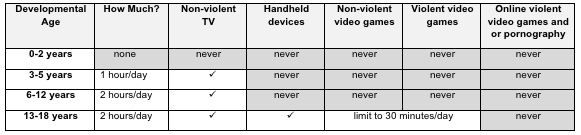
The
following Technology Use Guidelines for children and youth were
developed by Cris Rowan, pediatric occupational therapist and author of
Virtual Child; Dr. Andrew Doan, neuroscientist and author of
Hooked on Games; and Dr. Hilarie Cash, Director of reSTART Internet Addiction Recovery Program and author of
Video Games and Your Kids,
with contribution from the American Academy of Pediatrics and the
Canadian Pediatric Society in an effort to ensure sustainable futures
for all children.
Technology Use Guidelines for Children and Youth
Source: HuffingtonPost.com


