 Stone Mountain
is a
quartz monzonite dome monadnock in
Stone Mountain, Georgia, United States. At its summit, the elevation is 1,686 feet (514 m) MSL and 825 feet (251 m) above the surrounding area. Stone Mountain is well-known not only for its geology, but also for the enormous bas-relief on its north face, the largest bas-relief in the world.
The carving depicts three figures of the
Confederate States of America:
Stonewall Jackson,
Robert E. Lee, and
Jefferson Davis.
Stone Mountain is more than 5 miles (8.0 km) in circumference at its
base, and is surrounded by the Stone Mountain Park. The summit of the
mountain can be reached by a walk-up trail on the west side of the
mountain only, or by the Skyride aerial tram.

The mountain and carving
|
| Elevation | 1,686 ft (514 m) |
|---|
| Prominence | 825 ft (251 m) |
|---|
| Location |
|---|
| Location | Stone Mountain, Georgia, United States |
|---|
| Range | None |
|---|
| Coordinates |  33°48′21.40″N 84°8′43.52″W |
|---|
|
| Topo map |
USGS Stone Mountain, GA | | | | | | | |
|---|
Geology
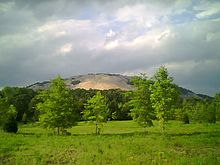
South side of Stone Mountain from the Songbird Habitat and Trail in 2009.
Stone Mountain is a
pluton, a type of igneous intrusion. Primarily composed of
quartz monzonite, the dome of Stone Mountain was formed during the formation of the
Blue Ridge Mountains, part of the
Appalachian Mountains.
It formed as a result of the upwelling of
magma from within the Earth's crust. This magma solidified to form granite within the crust five to ten miles below the surface.
Stone Mountain granite extends underground 9 miles (14 km) at its
longest point into Gwinnett County. Numerous reference books and Georgia
literature have dubbed Stone Mountain as “the largest exposed piece of
granite in the world". This misnomer is most likely a result of
advertisement by granite companies and early park administration. Stone
Mountain, though often called a pink granite dome, actually ranges in
composition from
quartz monzonite to granite and granodiorite.
The granite is of
quartz, plagioclase feldspar, microcline and muscovite, with smaller amounts of
biotite and tourmaline. The tourmaline is mostly black in color, and the majority of it exists as optically continuous skeletal
crystals, but much larger, euhedral pegmatitic tourmaline crystals can
also be found in the mountain's numerous, cross-cutting felsic dikes.
Embedded in the granite are
xenoliths or pieces of foreign rocks entrained in the magma.
The granite intruded into the metamorphic rocks of the
Piedmont region during the last stages of the
Alleghenian Orogeny, which was the time when North America and North Africa
collided. Over time, erosion eventually exposed the present mountain of
more resistant igneous rock, in processes similar to those that have
exposed
Devils Tower in Wyoming. This vein of granite also gave rise to
Arabia Mountain and
Panola Mountain in DeKalb County, smaller outcroppings further east of Stone Mountain.
The mountain's composition was described by one political commentator—and used as such as a simile for racial segregation in the 1950's—as "soft, exfoliating rock which turns to dust under the hammer."
Natural history

Summit of Stone Mountain, Kennesaw Mountain in Background
The top of the mountain is a landscape of bare rock and rock pools, and it provides views of the surrounding area including the skyline of downtown Atlanta, often
Kennesaw Mountain, and on very clear days even the
Appalachian Mountains.
On some days, the top of the mountain is shrouded in a heavy fog, and
visibility may be limited to only a few feet. The clear freshwater pools
of the summit form by rainwater gathering in eroded depressions, and
are home to unusual clam shrimp and fairy shrimp. The tiny shrimp appear only during the rainy season. Through the process of cryptobiosis, the tiny shrimp eggs (or cysts) can remain dormant for years in the dried out depressions, awaiting favorable conditions.

Leaves of the Georgia oak
The mountain's lower slopes are wooded. The rare Georgia oak
was first discovered at the summit, and several specimens can easily be
found along the walk-up trail and in the woods around the base of the
mountain. In the fall, the extremely rare Confederate Yellow Daisy (
Helianthus porteri) flowers appear on the mountain, growing in rock crevices and in the large wooded areas.
Confederate Memorial
The largest bas relief sculpture in the world, the Confederate
Memorial Carving depicts three Confederate leaders of the Civil War,
President Jefferson Davis and
Generals Robert E. Lee and
Thomas J. "Stonewall" Jackson (and their favorite horses,
"Blackjack", "Traveller", and
"Little Sorrel", respectively). The entire carved surface measures 3 acres (12,000 m
2),
about the size of two and a quarter football fields. The carving of the
three men towers 400 feet (120 m) above the ground, measures 90 by 190
feet (58 m), and is recessed 42 feet (13 m) into the mountain. The
deepest point of the carving is at Lee's elbow, which is 12 feet (3.7 m)
to the mountain's surface.
The carving was conceived by
Mrs. C. Helen Plane, a charter member of the
United Daughters of the Confederacy (UDC).
The Venable
family, owners of the mountain, deeded the north face of the mountain
to the UDC in 1916. The UDC was given 12 years to complete a sizable
Civil War monument.
Gutzon Borglum was commissioned to do the carving. Borglum abandoned the project in 1925 (and later went on to begin Mount Rushmore). American sculptor
Augustus Lukeman continued until 1928, when further work stopped for thirty years. In 1958, at the urging of Governor Marvin Griffin, the Georgia legislature approved a measure to purchase Stone Mountain for $1,125,000. In 1963,
Walker Hancock was selected to complete the carving, and work began in 1964. The carving was completed by
Roy Faulkner,
who later operated a museum (now closed) on nearby Memorial Drive
commemorating the carving's history. The carving was considered complete
on March 3, 1972.
Carving and the Ku Klux Klan

William J. Simmons founded the reborn Klan atop Stone Mountain in 1915

Atlanta Constitution clipping Nov. 28, 1915 describing the Klan re-establishment atop Stone Mountain

1925 Stone Mountain Memorial Half Dollar
Ku Klux Klan
activities at Stone Mountain are deep-rooted, although the original
conception of the memorial pre-dates the 1915 revival of the Klan. The
revival of the Ku Klux Klan was emboldened by the release of D. W. Griffith's Klan-glorifying film
The Birth of a Nation,
and by the lynching of Leo Frank, who was convicted in the murder of Mary Phagan.
On November 25, 1915, a group of robed and hooded men met at Stone
Mountain to create a new incarnation of the Klan. They were led by William J. Simmons, and they included a group calling itself the Knights of Mary Phagan. A cross was lit, and the oath was administered by Nathan Bedford Forrest II, the grandson of Gen. Nathan B. Forrest, and was witnessed by the owner of Stone Mountain, Samuel Venable.
Fundraising for the monument resumed in 1923, and in October of that
year, Venable granted the Klan easement with perpetual right to hold
celebrations as they desired.
The influence of the UDC continued, in support of Mrs. Plane's vision
of a carving explicitly for the purpose of creating a Confederate
memorial. The UDC established the Stone Mountain Confederate Memorial
Association (SMCMA) for fundraising and on-site supervision of the
project. Venable and Borglum, who were both closely associated with the
Klan, arranged to pack the SMCMA with Klan members.
The SMCMA, along with the United Daughters of the Confederacy continued
fundraising efforts. Of the $250,000 raised, part came from the federal
government, which in 1924 issued special fifty-cent coins
with the soldiers Robert E. Lee and Stonewall Jackson on them, but
would not allow the politician Jefferson Davis to be included.
When the state purchased the mountain in 1958, they had removed the
Klan and voided Venable's agreement by condemning the properties.
History
Human habitation of Stone Mountain and its surroundings date back into prehistory. When the mountain was first encountered by European explorers, its summit was encircled by a rock wall, similar to that still to be found on
Georgia's Fort Mountain. The wall is believed to have been built by early Native American
inhabitants of the area, although its purpose remains unclear. By the
beginning of the 20th century the wall had disappeared, the rocks having
been taken away by early visitors as souvenirs, rolled down the
rockface, or removed by the commercial quarrying operation. The mountain
was as well the eastern end of the
Campbelton Trail, a Native American path that ran through what is now the Atlanta area.
Europeans first learned of the mountain in 1597, when Spanish
explorers were told of a mountain further inland which was "very high,
shining when the sun set like a fire." By this time, the Stone Mountain
area was inhabited by the Creek and (to a lesser extent) Cherokee peoples. In 1790 the mountain was the site of a meeting initiated by President George Washington
in hopes of negotiating a peace treaty with the Creek. Instead a series
of wars ensued, and the Creek were forced to cede the land to the state
of Georgia in 1821.
In the early 19th century, the area was known as Rock Mountain. After the founding of DeKalb County and the county seat of Decatur
in
1822 Stone Mountain was a
natural recreation area; it was common for
young men to take their dates on horseback from Decatur to the
mountain.
Entrepreneur Aaron Cloud built a 165 foot (50 m) wooden observation
tower at the summit of the mountain in 1838, but it was destroyed by a
storm and replaced by a much smaller tower in 1851. Visitors to the
mountain would travel to the area by rail and road, and then walk up the
1.1 mile mountaintop trail to the top, where Cloud also had a
restaurant and club.
Granite quarrying started at Stone Mountain in the 1830's, but became a
major industry following the completion of a railroad spur to the
quarry site in 1847. This line was rebuilt by the
Georgia Railroad in 1869. Over the years, Stone Mountain granite was used in many buildings and structures, including the locks of the
Panama Canal, the
steps to the
East Wing of the United States Capitol and the
Imperial Hotel in Tokyo. In recent years, granite suppliers in Georgia sent stone samples cut from Stone Mountain to the Martin Luther King, Jr. Memorial Foundation to be considered for use in a planned monument in King's honor; the Foundation later chose to use granite imported from China.
Unfortunately, quarrying during earlier periods also destroyed several
spectacular geological features on Stone Mountain, such as the Devil's
Crossroads, which was located on top of the mountain.
In 1887 Stone Mountain was purchased for $45,000 by the Venable
Brothers of Atlanta, who quarried the mountain for 24 more years, and
descendents of the Venable family would retain ownership of the mountain
until it was purchased by the State of Georgia in the 1950's.
Martin Luther King, Jr.
mentioned the monument in his 1963
"I Have a Dream" speech in
Washington, D.C., when he said
"let freedom ring from Stone Mountain of
Georgia!"
During the
1996 Summer Olympics, Stone Mountain Park provided venues for Olympic events in
tennis,
archery and
track cycling.
The venues for archery and cycling were temporary and are now part of the songbird and habitat trail.
Aviation accidents

Grist Mill at Stone Mountain
According to George Weiblen's annotated calendar for Monday, May 7, 1928: "Mail plane crashed on mountain at 8:00 P.M."
Around dusk on September 16, 2003, in clear weather, a small airplane
circled the mountain five times, then crashed headlong into the south
side, bursting into flames and killing the pilot. A witness testifying
at the NTSB
investigation stated that the pilot, a 69-year-old accountant, had
threatened on multiple occasions to commit suicide by flying into the
mountain. The official NTSB accident report lists the probable cause as
"The pilot's intentional flight into the ground for the purpose of
suicide while impaired by alcohol."
Governance
Stone Mountain Park, which surrounds the Confederate Memorial, is
owned by the state of Georgia and managed by the Stone Mountain Memorial
Association, a Georgia state authority.
The Herschend Family Entertainment Corporation
currently has a long-term contract to operate park attractions while
the Stone Mountain Memorial Association retains ownership and the right
to reject any project deemed unfit.
Places of interest

Covered Bridge at Stone Mountain
Confederate Hall, operated directly by the Stone Mountain
Memorial Association or SMMA, is a museum that educates students and
park guests on the geology and ecology of Stone Mountain as well as
historical aspects of the area. A small theater shows a historical
documentary about the Civil War in Georgia called "The Battle for
Georgia".

Carillon at Stone Mountain Park; January 2012
The education department is host to thousands of students each school
year teaching the subjects of geology, ecology, and history. Classes
are designed to meet the Georgia Performance Standards and the North
American Association for Environmental Education guidelines.

Pavilion and transmitting tower at the summit of Stone Mountain
The
Antebellum Plantation and Farmyard is an open air museum
composed of 19 historic buildings, built between 1790 and 1875, which
have been re-erected to the site to represent a pre-Civil War
Georgia plantation.
The historic houses have been furnished with an extensive collection of
period furniture and decorations. The farm features live animals that
guests can pet.
A
732-bell carillon that originated at the
1964 New York World's Fair, provides a daily concert.
A
covered bridge, dating from 1892, which originally spanned the Oconee River in Athens, Georgia.
A
grist mill, dating from 1869 and moved to the park in 1965.
Broadcast tower

The mountain top and Skyride
The short broadcast tower on the top of the mountain transmits two non-commercial stations: television station WGTV TV 8, and weather radio station KEC80 on 162.55 MHz. FM radio station WABE
FM 90.1 was located on this tower from 1984 until 2005, when it was
required to relocate to accommodate WGTV's digital conversion.
W266BW FM 101.1 now has a permit as well. Atop the tower also sits the W4BOC Amateur Radio repeater which operates on a frequency on 146.760.
Scenic Railroad

Stone Mountain Scenic Railroad depot
(1971 photograph)
Stone Mountain Trails

Stone Mountain walk-up trail
Walk Up Trail: A 1.3-mile (2.1 km) trail to the top of Stone
Mountain ascending 786 ft (240 m) in elevation to a height of 1,686 ft
(514 m). The trail is steep, but spectacular panoramic views and cool
winds await hikers at the top.
Cherokee Trail: A 5-mile (8.0 km) National Recreation Trail,
the Cherokee Trail loops around the mountain base, with a mile section
going up and over the west side of the mountain (crosses Walk Up Trail).
Primarily passes through an oak-hickory forest, but views of the lakes,
streams, and mountain are common. map of Cherokee Trail
Nature Garden Trail: A scenic 3/4 mile loop trail through a
mature oak-hickory forest community. Excellent for viewing shade-loving
native plants. A small garden with interpretive native plant signs is at
the entrance to the trail.
Songbird Habitat Trails: Two loop trails each running one mile
(1.6 km). The field trail is an excellent birding spot and the woodland
trail provides shade and numerous native plants. Dogs are not allowed.
Attractions
The Park features several attractions that are operated by Herschend Family Entertainment Corporation.
On summer evenings the mountain hosts the
Stone Mountain Laser Show Spectacular,
which uses popular and classic music to entertain park guests with a
large fireworks and laser light display. The colorful lightshow of
lasers project moving images of the Deep South as well as Georgia
history onto the Confederate Memorial carving on the side of the
mountain. The American Civil War
is acknowledged, but the strength of a reunited country concludes the
message, with Sandi Patti singing the Star Spangled Banner. There are
still old favorites included with the show, “Devil Went down to Georgia”
and "An American Trilogy". There have been several additions to the
show for its 25th anniversary. During Memorial Day Weekend of 2011,
Stone Mountain unveiled their biggest overhaul ever of the laser show,
dubbed
Mountainvision. This incorporates digital projectors,
lasers, special effects, and pyrotechnics into an incredible experience.
The projection is 5 times larger than an IMAX screen and taller than
the Statue Of Liberty.
The
Skyride is a Swiss-built cable car to the summit of the mountain which passes by the carving on the way up.
The
Riverboat offers a scenic cruise aboard a reproduction Mississippi riverboat on 363 acre (147 ha) Stone Mountain Lake. (
UPDATE: The Riverboat, which used to be one of Stone Mountain Park's attractions to all guests, is now available for events only.)
The
Antebellum Plantation is a collection of historic
buildings relocated from around the state of Georgia, including 3
plantation manor houses dating from 1794, 1850 and 1845, two slave
cabins, a barn and other outbuildings. The Plantation Farmyard features
historic breeds of sheep, goats and pigs that guests can pet.
Crossroads is a recreation of an 1872 southern town with several attractions including a modern 4-D movie theater, an adventure mini-golf course, a duck tour ride, stores and restaurants. Crafts demonstrators include glass blowing and candy making. Other attractions in this area include:
The
Great Barn is a children's activity area that features 65 interactive games, climbing structures, trampoline floors, slides and more.
Sky Hike is a family ropes adventure course. Guests can choose their own path and level of challenge.
Geyser Towers is a playground featuring a large fountain at
the entrance, so guests have the option of climbing through the course
or getting wet.

Panoramic view from the top of Stone Mountain
External Links
- Atlanta, Georgia, a National Park Service Discover Our Shared Heritage Travel Itinerary
- City of Stone Mountain, Georgia, from the City of Stone Mountain*Main Street Stone Mountain
- Stone Mountain article, from the New Georgia Encyclopedia
- Stone Mountain Park and City Information*Stone Mountain Park Photos
- Stone Mountain Park website, from the state authority that owns the park
- Stone Mountain Park photo gallery, with current and historical photos
- View from the top of Stone Mountain looking Northeast (1934) and Granite Quarry at Stone Mountain (1913) from the Georgia Geological Survey photographs in the collection of the Georgia Archives.
- Stone
Mountain Granite Corporation – Producers and Manufacturers Stone
Mountain Light Gray Granite For Building Work – Dorian Gray For
Mausoleums and Monuments & Stone Mountain Granite Corporation Granite Price List, circa 1914 (Office, quarries, and finishing plant located at Stone Mountain, Georgia)
- Southeast Granite Company - Stone Mountain Granite Memorial/Monumental Stones Catalog
- Stone Mountain Scenic Railroad
- The Herschend Family Entertainment Corporation
- Georgia Railroad
- Ku Klux Klan
- Stone Mountain Memorial Half Dollar
- Roy Faulkner finished memorial
- Walker Hancock worked on Memorial
- Augustus Lukeman
- Gutzon Borglum Started Monument
- Piedmont region
- Alleghenian Orogeny
- Arabia Mountain in DeKalb County
- Panola Mountain in DeKalb County
- quartz monzonite
- dome monadnock
- Stone Mountain, Georgia
- pluton
- magma
Source: Internet


