Braselton is a town in Barrow, Gwinnett, Hall, and Jackson counties in the U.S. state of Georgia, about 40 miles (64 km) northeast of Atlanta. As of the 2010 census, the town had a population of 7,511,
with an estimated population in 2012 of 7,875
.

Chateau Elan
The Gwinnett and Barrow County portions of Braselton are part of the Atlanta–Sandy Springs–Marietta, GA, Metropolitan Statistical Area, and the Hall County portion is part of both the Atlanta and Gainesville, GA Metropolitan Statistical Areas. The remaining Jackson County portion of Braselton is not part of any core based statistical area.

BETTIS SPEAKS ABOUT CITIES’ PAST
Robbie
Bettis, owner of the Braselton Antique Mall and Ye Olde Station
antiques in Hoschton, shows a photo of the first post office in
Hoschton. Bettis talked to the Friends of the Braselton-West Jackson
Library, Inc. during the group’s annual meeting last week about the
histories of Braselton and Hoschton.
A history of two cities
Group learns about histories of Braselton, Hoschton
Braselton
and Hoschton may seem today to be molding their own futures, but their
pasts are tied to one another by a few things — including a railroad,
former American Indian trails and family blood.
Robbie Bettis, owner
of the Braselton Antique Mall and Ye Olde Station antiques in Hoschton,
told members of The Friends of Braselton-West Jackson Library, Inc. last
week about the two cities’ histories.
Bettis’ book, “Passing,” which explains how the small town-atmosphere is dying, is expected to be published this summer.
Braselton and Hoschton grew around the Mulberry River, which is the modern-day border between Jackson and Barrow counties.

Mayfield Dairies Visitors Center
Indians
used the path of the Mulberry River for their trails, which later
became the routes for Ga. 211 and Ga. 53, Bettis said. An Indian burial
mound is located off the banks of the Mulberry River on Hog Mountain
Road in Barrow County.
Hog Mountain Road — which is also known as
Peachtree Road and Covered Bridge Road — was a vital road in the
founding of Hoschton, Bettis added.
And the beginning of Hoschton can be traced to 1813, when Henry Hosch moved from South Carolina to Walton County.
Hosch
bought land from several Northeast Georgia counties, including Jackson
County in the 1840's, Bettis said. He married Matlida Camp in 1837, and
their first daughter, Susan, was born in Walton County. Eight children
would be born in Hoschton.
Lt. Hosch volunteered to fight in the
Civil War following a recruitment gathering at Rockwell Church. He
immediately left for battle without saying good-bye to his family,
Bettis said.
Hosch died in Richmond, Va. in 1862, following an illness. He is buried in a copper coffin in the Hoschton cemetery.
In
1867, Susan Hosch married William Harrison Braselton, who was
considered “beneath her,” Bettis said. Susan was trained in the fine
arts, while William Harrison was a “dirt farmer,” she said.
It was soon after that controversial wedding took place that the two cities truly began to establish their townships.
Susan
Hosch’s brothers, John and Russell, opened the Hosch Store when they
were 15 and 10, respectively. A post office opened in the town in 1878
and a school began operating in 1881.
THE RAILROAD COMES TO TOWN
The
town didn’t receive its name until a railroad company wanted to lay
track in the growing village, Bettis said. The town’s founding brothers —
John Robert (J.R.), Russell Angel (R.A.), Henry Andrew and William —
divided Hoschton into 3/4-acre lots, starting from the new train
station.
“The railroad became an extremely important thing for towns and cities,” Bettis said.
The
railroad service between Gainesville to Social Circle began operating
through Hoschton in 1882. Service ended in 1947. During that time,
passengers may have boarded the train at the Hoschton Depot, while
merchandise was delivered at a stop at the Braselton Brothers Store.
That
store’s roots began in 1887, when John Oliver Braselton — one of three
sons of William Harrison and Susan Braselton — starting selling items to
field hands. In 1904 the “Three Bs,” brothers John Oliver, Green and
Henry, opened a brick store.
Business was so good for the Braselton
Brothers Store, that it was expanded in 1910 and a bank was added in
1911, Bettis said. The brothers also built a cotton gin, enterprise
flour and grist mill, blacksmith shop, co-op fertilizer plant and saw
mill.
And business was doing well in Hoschton, too.
In 1898, the
city had 10 stores, two drug stores, two blacksmith shops, a millinery
shop, a planning mill, a shoe shop, a wood working shop, a tannery and
harness shop, a gristmill, four boarding houses, a soda bottling shop
and a cotton gin.
DOCTORS FLOURISH IN CITY
The medical profession also lured more people to Hoschton, Bettis said.
During
its early history, the city had numerous doctors, including William
“Bud” DeLaPerriere, Earnest DeLaPerriere, J.W. Darby, Ralph Freeman,
L.C. Allen, and Myron Allen.
Dr. L.C. Allen and his son, Myron,
opened the Allen Clinic in the 1930's (which is today located on the
corner of Peachtree Road and Ga. 53). The clinic severed numerous
patients throughout Northeast Georgia, including the “mountain folks”
who would camp on the clinic’s yard until visited by a doctor, Bettis
said.
L.C. Allen’s clinic once operated in the city square in the
building that is today city hall. He lived in an antebellum house on
White Street that has seen its use as a tea house in recent years.
Myron
Allen, on the other hand, became the talk of Hoschton when he
accidentally shot his wife in 1936. Allen was still practicing on
patients before he was acquitted of his wife’s death by a Jackson County
jury, Bettis said.
Hoschton also owes its history to another family who settled in West Jackson.
The DeLaPerriere family — which has a “French Connection” — first moved to Jackson County in the early 1880's.
In
1785, the Georgia General Assembly gave Count Charles Hector Theodat
D’Estaing 20,000 acres in what would later become Jackson and Banks
counties. The land gift was the legislators’ way of thanking D’Estaing
for his assistance in Savannah during the American Revolution.
But,
D’Estaing probably never saw his Georgia land — he was beheaded in 1794
during the French Revolution. The 20,000 acres was given to his sister,
whose first husband was General Ange DeLaPerriere. Their son, Ange, is
considered the ancestor of the present DeLaPerriere family.
Ange
DeLePerriere was a doctor, and state representative and senator. He
settled near the present-day spot of West Jackson Middle School and is
believed to be buried on the Traditions of Braselton property, Bettis
said.
HISTORIC HOUSES
In the early 1900's, the three Braselton brothers built their homes, which are still occupied today.
 The Story of the great house on the corner
John
Oliver Braselton’s house, which was built in 1904, is located on the
corner of Ga. 53 and Ga. 124 and is today the home of former mayor Henry
Edward Braselton, John Oliver’ son.
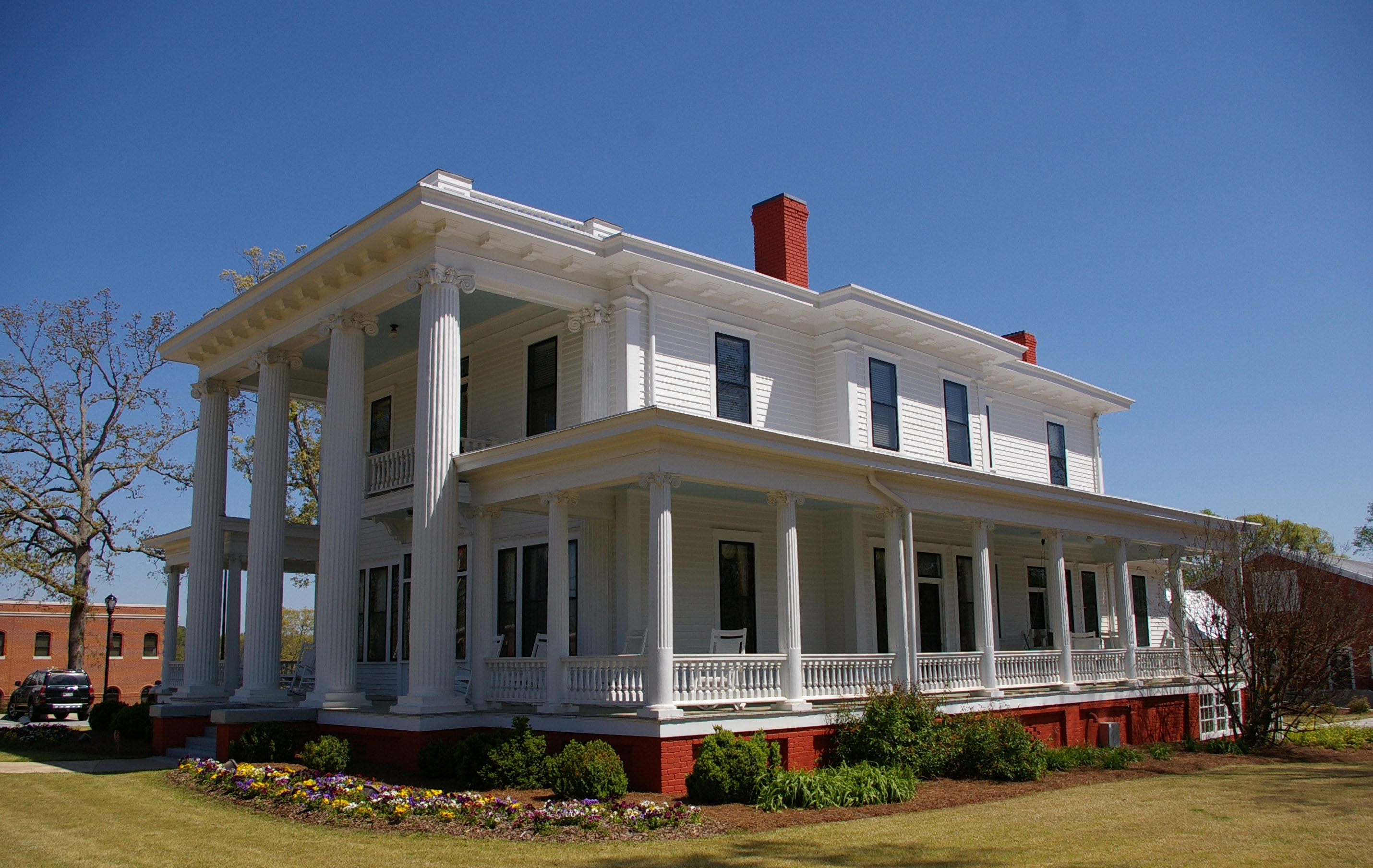
Henry Braselton’s house was
built and in 1910 and is now the Braselton Town Hall. The house was
extensively remodeled in the late 1990s and Bettis described the
building as “one of the most beautiful city halls in the state.”
 Braselton-Stover House
In 1918, Green Braselton built his house on Ga. 53. Today, the Braselton-Stover House operates from the building.
The
Hosch brothers also built their homes on their land. John Hosch’s
house, which was built on Ga. 53, is now occupied by Prudential Georgia
Realty.
A real estate deal in 1990 brought national media to
Braselton, when the Basinger Group — which included actress Kim Basinger
— purchased the town for $20 million. The town was first listed on the
real estate market in 1980 for $17 million, Bettis said. Braselton was
sold again to a group of developers in 1994.
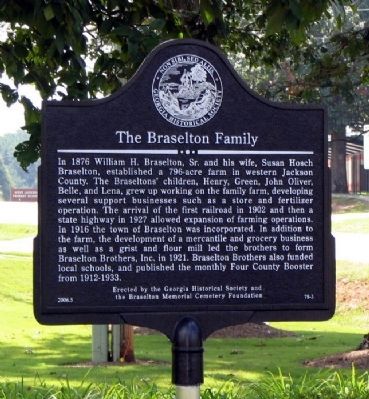
The Braselton Family
| |
|
| 
By David Seibert, September 16, 2006 |
|
|
|
| 1. The Braselton Family Marker |
| |
Inscription. In
1876 William H. Braselton, Sr. and his wife, Susan Hosch Braselton,
established a 796-acre farm in western Jackson County . The Braseltons’
children, Henry, Green, John Oliver, Belle, and Lena , grew up working
on the family farm, developing several support businesses such as a
store and fertilizer operation. The arrival of first the railroad in
1902 and then a state highway in 1927 allowed expansion of farming
operations. In 1916 the town of Braselton was incorporated. In addition
to the farm, the development of a mercantile and grocery business as
well as a grist and flour mill led the brothers to form Braselton
Brothers, Inc. in 1921. Braselton Brothers also funded local schools,
and published the monthly Four County Booster from 1912-1933.
THE ‘WOG’
And local history stories wouldn’t be complete without a mysterious figure — in this case, the “Wog.”
“Every great story has to have a creature,” Bettis joked.
An
early history book of Jackson County recounts that the “Wog” was
supposedly seen lurking on Hog Mountain Road in Hoschton and near Jug
Tavern (which is now Winder).
According to one written account, the
“Wog” was described by locals as a creature with a “bear-like head,”
with black hair “ugly lips,” a forked tongue and a large tail in
constant motion. Like a local “boogie-man” figure, it was common for
parents to tell their children about the “Wog,” Bettis said.
“Well, I hate to tell everybody, but it was a legend,” she said.
Source: mainstreetnews.com
Braselton Flour and Grist Mill
Text from an article in the Braselton News, January 6, 2010.
It's
been quietly sitting in the heart of downtown Braselton for probably a
century - but little is known about the former state-of-the-art mill.
Located at the intersection of Ga. Hwy. 53 and Frances Street - across
from Northeast Georgia Bank - the Enterprise Flour and Grist Mill in
Braselton was once considered one of the most modern operations for
converting grain into flour.
While
no one knows for certain when the three-story wooden building was
constructed, writing from an old photo says the roller mill was built
around 1900. Most likely, it was one of several businesses started
around the turn of the 20th century by the town's founding brothers -
the "3Bs" - who established the Braselton Brothers Store, just one block
from the mill. It survived a tornado that hit the town in 1920, but
destroyed the first Braselton High School a block away.
An
article from The Atlanta News in 1907 describes the first full roller
process flouring mill in Northeast Georgia. "Their complete Murray
ginning system is up to date and has a fine patronage, ginning from 800
to 1,000 bags every season," according to the article. "It is always a
place of push and system and it infuses new life in one to visit there
and see the wonderful accomplishments of these young men in the past few
years."
A
1939 article from The Jackson Herald said the building contained "a
wheat mill with the latest and best machinery that money can buy."
Herbert B. "Kit" Braselton, 89, remembers installing equipment in the
roller mill - where self-rising flour was produced. "That was unusual
for a rural mill to make self-rising flour," he said. The Braselton mill
produced two brands, "Three Bs" and "Fast Flyer."
"People
came from great distances for their wheat that they ground," Kit
Braselton said. The mill had a daily capacity of 50-70 barrels of flour
and 300 bushels of meal, according to the 1907 The Atlanta News article.
Today, nobody in the town knows how the equipment in the Braselton mill
was operated, said town manager Jennifer Dees.
Robbie
Bettis, who has written a book about the history of Braselton and
Hoschton, said it is believed to be the last mill in Georgia to make
self-rising flour. The mill probably stopped operation in the 1950s.
"It's really in excellent shape for something as old as it is," she
said. Inside, it looks as though the old mill could start running again -
the equipment remains virtually untouched, the belts appear strong and
wheat dust from the last run decades ago is scattered throughout the
building.

It
is believed that John Braselton, who once lived in the residence that
is now town hall, was the last person to operate the mill. A tour of the
building reveals mementos of the decades from Braselton. There's
graffiti with a Bible verse written on a wall with a date of 1943. Food
boxes from the former Dado's Foods restaurant, which was demolished in
2004 to make way for a new Northeast Georgia Bank branch, litter the
interior near a few windows. And there's plenty of beer cans from brands
once popular in the 1970s.

For
now, town officials plan to spend 2010 stabilizing the building and
weatherizing it. The roof was replaced several years ago. The building
won't be affected by the upcoming realignment of Ga. Hwy. 124 behind the
Braselton Brothers Store, although an old telephone building near the
structures will be relocated. The town now owns the building, but
officials haven't decided what - if anything - to do with the interior
of the old mill. "The exterior is relatively easy, but we've got to
figure out what to do with the interior," said town manager Dees.
Another -and more well known - grist mill, Sells Mill, was opened in
1914. Jackson County bought the mill's property located on Jackson Trail
Road in Hoschton in 2000 for a park and renovated the mill in 2005.
The
photos below were a part of the same newspaper article. As you can see
from the photo above, the mill is not open to the general public.
And
one last photo that I took on this breezy January morning, 2010. It's
nice to know that this old mill will be around for a long time to come
(with a lot of work).
History
The town is named after Harrison Braselton, a poor dirt farmer who
married Susan Hosch, the daughter of a rich plantation owner. Braselton
built a home on 786 acres (318 ha) of land he purchased north of the
Hosch Plantation. The land he purchased was later called Braselton.
In 1989 actress and Georgia native Kim Basinger bought the town for $20 million, intending to turn it into a tourist destination.
Five years later, on the eve of personal bankruptcy, she and her partners sold the town at a large loss.
William Henry Braselton, the first mayor of
Braselton, built this house in the early 1900's. Today it is used as
Braselton's town hall, and the structure is rumored to be haunted.
The town of Braselton, incorporated in 1916, occupies thirty-four square miles in northeast Georgia, spreading across Barrow, Gwinnett, Hall, and Jackson
counties. In 1876 William Harrison Braselton bought 800 acres of land
and built a plantation on it. His eldest son, William Henry, served as
the first mayor of Braselton. Descendents of the Braseltons continued to
serve on the city council until 2001, when Henry Edward Braselton lost
the title of mayor to Pat Graham.
The headstones of William H. and Susan F.
Braselton, the founders of the town of Braselton, are located in the
Braselton family graveyard off Jesse Cronic Road.
In 1887 one of William Harrison Braselton's sons, John Oliver, then eight years old, constructed a six-foot-by-six-foot merchandise
house in the yard to sell items to the farmhands on the plantation.
Eventually, his two brothers joined in his investment, and with their
father's encouragement, the miniature store turned into a thriving
business along the railroad
tracks that ran through the family's property. The enterprise became
the Braselton Brothers, with the motto "Dealers in Everything." The
store, which in its fourth iteration in 1904 included a brick warehouse,
was a sixty-by-ninety-five-foot structure with fourteen-foot walls and a
thirty-by-sixty-foot basement for heavy groceries. Serving Gwinnett,
Hall, and Jackson counties, the store sold groceries, dry goods,
notions, shoes, and millinery and clothing. The town's first bank was
added to the structure in 1911. A tornado destroyed it in 1919, but with
help from the community, it was rebuilt.
In the early 1980's Donald and Nancy Panoz, owners of the Elan Corporation, a drug-delivery products and technology company, established the 3,500-acre Chateau Elan
Resort and Winery in Braselton, a major attraction. In 1999 Donald
Panoz founded the American Le Mans Series (ALMS), a series of automobile
endurance races. Many factory-backed and privateer teams compete with
some of the world's most exotic sports cars. The Panoz Esperante, a
handmade, American sports car, is built in Braselton by the Panoz Motor
Sports Group. The International Motor Sports Association and the premier
racing circuit Road Atlanta (which hosted one ALMS race in 2006) are
also located in Braselton.
In the late 1980's the actress Kim Basinger,
a Georgia native, selected Braselton as a suitable location for
developing a tourist attraction that would feature movie and recording
studios, boutiques, and a film
festival. She headed an investment group that purchased the 1,800-acre
town for $20 million. Due to financial problems, however, Basinger
dropped her plans and sold the town in 1993 for just $1 million.
The bell that once rang for the Braselton High School, from 1920 to 1957, now sits on the grounds of Braselton's town hall.
Eventually, Braselton
expanded its boundaries and attracted major companies, turning the
small town into a booming residential and manufacturing area. The
Mayfield Dairy Visitors Center opened in 1997, Panoz Auto Development
Company opened in 1999, and Haverty's Distribution Center opened in
2002.
Parks and rural space are important to the
residents of Braselton. In addition to the Braselton town park and a
multiuse park along the Mulberry River, Braselton is home to the
Thompson Mills Forest, Georgia's official state arboretum. With 330
acres of native trees and plant species from the Appalachian region and
the world, the research forest, managed by the University of Georgia's Warnell School of Forestry, serves as an educational facility.
Many historic structures have been preserved
in Braselton, in addition to the Braselton Brothers store.
The new town
hall was built in 1909 and restored in the late 1990s. The
Braselton-Stover House, originally built by Green Braselton in 1918, has
been renovated and is a popular site today for weddings and receptions.
According to the 2010 U.S. census, Braselton's population was 7,511, an increase from the 2000 population of 1,206.
Geography
Braselton borders the mailing addresses (not city limits) of Gainesville (Candler), Flowery Branch, Oakwood (Chestnut Mountain side), and Pendergrass. The town borders the city limits and shares a ZIP code with Hoschton.


