
African Americans had attended and participated in the
Tri-State Fair well into the 1870's. Following the
collapse of Reconstruction and the 1896 "separate but equal"
legalized segregation, Memphis blacks and whites
occupied two separate societies. In 1911, prominent
African-Americans founded, organized, and ran their own fair
called the "Negro Tri-State Fair". It was held at the
Fairgrounds a few days after the white fair closed. This
was an important event in the black community for decades.
When the white fair changed its name to the Mid-South Fair in
1928, the black fair became simply the Tri-State Fair until it
was discontinued in 1959. The Mid-South Fair was
integrated in 1962.
Source: historic-memphis.com
Showing posts with label Memphis. Show all posts
Showing posts with label Memphis. Show all posts
Sunday, August 20, 2017
Sunday, January 15, 2017
Edward Hull (E.H.) Crump
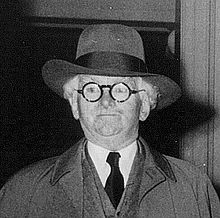
Edward Hull "Boss" Crump in 1945
Edward Hull "Boss" Crump (October 2, 1874 – October 16, 1954) was an American politician from Memphis, Tennessee. Representing the Democratic Party, he was the dominant force in the city's politics for most of the first half of the 20th century, during which the city had a commission form of government. He also dominated Tennessee state politics for most of the time from the 1920's to the 1940's. He was elected and served as mayor of Memphis from 1910 through 1915, and again briefly in 1940. But, he effectively appointed every mayor elected from 1915 to 1954.
Career
A native of Holly Springs in northern Mississippi, where he was born in 1874, Crump at the age of 19 moved to Memphis, Tennessee on September 21, 1893, according to the Holly Springs Reporter.When he first arrived in Memphis, the ongoing Panic of 1893, the worst recession in the United States history to that time, made it hard for Crump to find work. Eventually, he obtained a clerical position with Walter Goodman Cotton Company located on Front Street in downtown Memphis. This was the start of a successful business career as a broker and trader.In early 1901, Crump began seriously courting a 23-year-old young woman by the name of Bessie Byrd McLean. Bessie, or "Betty," McLean was a prominent Memphis socialite and has been described as "one of the city's most beautiful and most sought after women." She was the only child of Mr. and Mrs. Robert McLean. Her father was then serving as the vice president of the William R. Moore Dry Goods Company. Crump and McLean were married on January 22, 1902 at the Calvary Episcopal Church.
Politics
Alongside his rising business career, Crump began to make the political connections that served him for the rest of his life. He was a delegate to the Tennessee Democratic State Convention in 1902 and 1904. In 1905, he was named to the municipal Board of Public Works, and was elected to the powerful position of Commissioner of Fire and Police in 1907, among three commissioners who governed the city.Starting in the 1910's, Crump began to build a political machine which came to have statewide influence. He was particularly adept in his use of what were at the time two politically weak minority groups in Tennessee: blacks and Republicans. Unlike most Southern Democrats of his era, Crump was not opposed to blacks voting; Memphis blacks were reliable Crump machine voters for the most part. The party often paid the poll taxes required by state law since the late 1880's; otherwise this requirement resulted in disenfranchising many poor blacks. One of Crump's lieutenants in the black community was funeral director N. J. Ford, whose family (in the persons of several sons, including Harold Sr. and John Ford, daughter Ophelia, and grandson Harold, Jr.) became influential in Memphis, state and national politics, continuing to be so today. A symbiotic relationship developed in which blacks aided Crump, and he aided them, as was usual in politics. Crump also skillfully manipulated Republicans, who were numerically very weak in the western two-thirds of the state due to the disenfranchisement of blacks, but dominated politics in East Tennessee. Frequently, they found it necessary to align with Crump in order to accomplish any of their goals in the state government.
Crump was influential for nearly half a century. He usually preferred to work behind the scenes and served only three two-year terms as mayor of Memphis (1910–1915) at the beginning of his career. He essentially named the next several mayors. His rise to prominence disturbed many of the state political leaders in Nashville. The "Ouster Law", designed to remove officials who refused to enforce state laws, was passed primarily with Crump and his lax enforcement of state Prohibition in mind. He was county treasurer of Shelby County from 1917 to 1923. He was elected seven times as a delegate to the Democratic National Convention.
Crump became involved in earnest in state politics during the 1928 gubernatorial election when Henry Horton was seeking election in his own right. Horton had earlier been speaker of the state senate and succeeded to the position of governor when Austin Peay died in office. Crump supported Hill McAlister in the Democratic primary, while the Nashville machine of Luke Lea supported Governor Horton. Horton won the primary despite the strong vote for McAlister in populous Shelby County. When Horton ran for reelection in 1930, Crump and Lea cut a deal, and Crump swung his formidable political machine behind Horton. Horton defeated independent Democrat L. E. Gwinn in the primary and Republican C. Arthur Bruce in the general election.
After years of working behind the scenes, Crump decided to run for U.S. Representative in 1930. He was easily elected to the Tenth District, which was then co-extensive with Shelby County (it became the Ninth in 1932). He served two terms: from March 4, 1931 to January 3, 1935. (The Twentieth Amendment was enacted in 1933, shifting the starting date of Congressional terms.) During this time, he was also a regent of the Smithsonian Institution. He remained hugely influential in Memphis as well. He was in constant communication with his operatives there and visited during each congressional recess.
In 1936, Crump was named to the Democratic National Committee, serving on that body until 1945. In 1939 he was elected a final time as mayor, although that term was officially served by Walter Chandler. Chandler was U.S. Representative for the Ninth District, and Crump thought that Chandler's time was better spent tending to congressional matters in Washington than campaigning for mayor in Memphis. So, without a platform, without a speech, and without opposition, Crump was elected mayor of Memphis.
Crump was sworn in at a few minutes past midnight on January 1, 1940, in a snow storm on the platform of the railroad station, just before leaving for New Orleans to see the Sugar Bowl. In high humor, he resigned immediately. Vice Mayor Joseph Boyle became Mayor till the next day, when the faithful City Commission met and elected Chandler. Watkins Overton's term had ended at midnight, and thus Memphis had four mayors in less than twenty-four hours.
Crump's statewide influence began to wane in the late 1940's. Edward J. Meeman, editor of the Memphis Press-Scimitar, opposed Crump's initiatives and called for a city manager government and abolition of the poll tax to weaken the power of the machine. He also worked to unseat U. S. Senator Tom Stewart, whom Crump supported in the 1948 Democratic primary against his intra-party challenger, U.S. Representative Estes Kefauver. Gordon Browning, a one-time protégé whom Crump had helped elect governor in 1936, was elected governor again in 1948, this time over Crump's opposition. For the rest of his life, Crump's influence was largely limited to Memphis. In 1952, his longtime associate, Senator Kenneth McKellar, was defeated in the Democratic primary — in those days with a practically powerless state Republican party, the real contest in Tennessee — by Congressman Albert Gore, Sr.. A final triumph for Crump was the victory in 1952 of his chosen candidate, Frank G. Clement in the gubernatorial primary over Browning.
Crump died less than two years later. He is interred at Elmwood Cemetery in Memphis.
The Crump machine
From the 1910's to the 1950's, Memphis was a locus of machine politics under the direction of "Boss" Crump, a Democrat. He obtained a state law in 1911 to establish a small commission to manage the city. The city retained a form of commission government until 1967 but Crump was in full control at all times. He used all the familiar techniques of the big city boss: ballot manipulation, patronage for friends, and frustrating bureaucratic obstacles for the opposition. Crump built a complex alliance with established power figures at the local, state, and national levels. He ensured that dissidents had little or no voice. At the center of his network was "Cotton Row": the business elite that dominated the cotton industry. Second, he included the modernizers: business-oriented progressives who were most concerned with upgrading the city's waterfront, parks, highways, and skyscrapers, as well as a moderately good school system. Working-class whites got their share of jobs, but labor unions were of marginal influence. Roger Biles argues that the political system was virtually unchanged from 1910 into the 1950s and 1960s, thanks to Crump's wire-pulling. Crump was the leading Tennessee supporter of Franklin Roosevelt and the New Deal. In return, the city received ample relief programs, which provided jobs for the unemployed, as selected by machine lieutenants. The city also got major federal building projects, which helped fund the business community. Crump incorporated the black leadership in his outer circle, dispensing patronage in return for the black vote. Memphis was one of the largest southern cities in which blacks could vote, but segregation was as rigid as anywhere.Legacy

Statue of E.H. Crump in Overton Park, Memphis, Tennessee.
- Crump was a strong supporter of fire service and for many years the Memphis Fire Department was considered one of the best in the country; it still has a high reputation.
- He believed that separate operations for each municipal utility were inherently inefficient and combined them; in the early 21st century, Memphis Light, Gas and Water is one of the largest combined municipal utilities in the United States.
- Crump thought that cities should not be too noisy; Memphis has strong noise ordinances that are more aggressively enforced than those of many other jurisdictions.
- He was an early supporter of requiring automobile safety inspections; all of Memphis-registered vehicles were inspected annually (twice a year until the 1990s), until June 28, 2013, when all city inspections ceased after a de-funding of the department by the Memphis City Council.
- The city's Crump Stadium and Crump Boulevard are named after him.
- The lyrics to The Memphis Blues by composer and bandleader W.C. Handy mention "Mr. Crump." The song was published in 1912, but may have originated during Crump's 1909 mayoral campaign.
Boss E. H. Crump's Influence In Politics
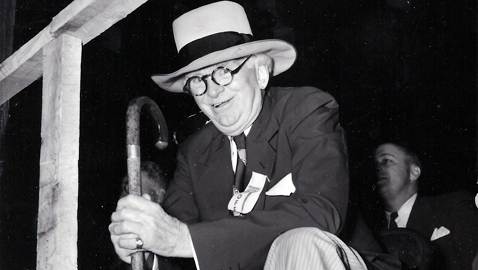
Despite encountering stiff opposition to the candidates supported by Shelby County Boss E. H. Crump and Tennessee’s senior United States Senator Kenneth D. McKellar, the two men were supporting Jim Nance McCord for governor in 1944.
McCord had been elected to a single term in Congress, but had held one elective office or another in his native Marshall County for decades. McCord ran for the Democratic gubernatorial nomination without opposition and easily won the general election. Both McKellar and Crump supported Franklin D. Roosevelt’s unprecedented bid for a fourth term that same year.
FDR summoned Crump to the White House as he began his fourth term for a conference. The purpose of the conference was to encourage Crump to convince Senator K. D. McKellar to retire in 1946. Roosevelt was anticipating the post-war world and he thought it would be a better one without McKellar in the Senate. McKellar was then reaching the apex of his political career and wielded enormous influence in the United States Senate. He had just been elected President Pro Tempore by his colleagues and was the Acting Chairman of the Senate Appropriations Committee, as well as Chairman of the Senate’s Post Office Committee. FDR likely did not wish to have to contend with the McKellar influence in the Senate.
Crump told President Roosevelt that McKellar intended to run again in 1946 and to which FDR replied that if he did, McKellar would be beaten. Crump, understanding Tennessee politics far better than FDR, retorted McKellar would not only run again, but would be reelected to a sixth term. Crump was right; McKellar was reelected to another term in the United States Senate and by that time FDR lay in his own grave.
Crump decided in 1945 to give up his post as Tennessee’s committeeman on the Democratic National Committee. Morristown businessman Herbert S. “Hub” Walters, a McKellar stalwart, took Crump’s place on the national committee.
The opposition to the McKellar – Crump domination of Tennessee politics made a stronger effort in the 1946 elections. Edward “Ned” Carmack had quite nearly defeated junior United States Senator Tom Stewart in 1942 and Stewart’s margin of victory had come from Shelby County. Carmack was eager to hold public office and had announced as a candidate for governor in 1944, but had dropped out well before the primary. Chattanooga Congressman Estes Kefauver had seriously considered running against McKellar, but after making a few inquiries decided the old senator was still a formidable candidate. Kefauver opted to run again for Congress, leaving Carmack to make the race against Senator McKellar.
Jim McCord was to be opposed by former governor Gordon Browning, who remained in Europe following the allied victory in World War II as part of the military government. Browning’s campaign would be run in absentia, while Carmack carried most of the brunt of the actual campaigning. McCord and McKellar ran as a ticket, along with Andrew “Tip” Taylor for the Public Service Commission. As it turned out, McKellar’s own campaign was run in absentia. Despite several announcements McKellar was returning to Tennessee to personally participate in the campaign, the senator remained in Washington, D. C. Tennessee was brutally hot throughout the summer of 1946 and Senator McKellar was plagued by various ailments and illnesses and his campaign managers thought it best for him to remain at his post of duty in the Senate.
Tennesseans were once again treated to Crump purchasing full-page ads in newspapers throughout the state promoting Senator McKellar and Governor McCord. In his ads, the Memphis Boss ridiculed the opposition to the McCord – McKellar ticket. Crump’s loathing of Gordon Browning was as profound as ever. Crump’s comments about the former governor were as pointed as they had been during Browning’s failed reelection bid in 1938. Crump had claimed a particular art gallery in France held no less than twenty-six pictures of Judas Iscariot and opined, “None look alike, but they all resemble Gordon Browning.”
Unlike 1942, the election was not close. Senator McKellar thrashed Ned Carmack without having even returned once to Tennessee to campaign for reelection personally. Governor McCord easily defeated Gordon Browning. It was to be the last election which the McKellar – Crump alliance won a smashing victory.
Yet in Memphis Crump remained as strong as ever. Memphis had won several nationally prestigious awards over the years and the municipal stadium in Memphis was named for Crump. The machine’s candidates occupied virtually every office in both the city and county governments.
As the 1948 elections loomed, Crump, like many Southerners, was growing increasingly alarmed by President Harry Truman’s commitment to civil rights. Oddly one of Crump’s strongest objections to Truman was the fact the Missourian had come from the Pendergast machine in Kansas City. Crump and McKellar both were dissatisfied with Truman and the Memphis Boss was soon indicating he would support the State’s Right ticket of South Carolina Governor Strom Thurmond and Mississippi Governor Fielding Wright. McKellar refused to leave the Democratic Party following the convention nominating Truman, but he told Crump he held out little hope for Truman being elected.
Crump’s dissatisfaction was hardly confined to Harry Truman; the Memphis Boss was not enthused about Senator Tom Stewart, who was also up for reelection in 1948. Crump had been mortally embarrassed wen Stewart had been reelected in 1942 on the basis of the vote returns in Shelby County. Crump was also constantly reminded by Will Gerber, a prominent attorney and sometime Crump officeholder in Shelby County, that Stewart very well might be anti-Semitic, though there was little in Stewart’s record to reflect that allegation. In December of 1947 came the announcement Crump would not support Senator Stewart for renomination in the Democratic primary the following year. Many expected Stewart to simply meekly retire to private life rather than run again and Crump probably thought the same thing. Stewart stubbornly insisted he would be a candidate with or without Crump’s support. Congressman Estes Kefauver, seeing his opportunity with the split in the machine, declared he, too, would be a candidate. It proved to be Crump’s single biggest political miscalculation and mistake.
Crump’s senatorial candidate was Judge John A. Mitchell of Cookeville who was a cousin of former Congressman J. Ridley Mitchell, who had been a Crump opponent. Crump had never even met John Mitchell, although he related he heard fine things about the judge.
Senator McKellar wrote Crump to say he had informed his junior colleague that he could not help him win reelection and noted Stewart had taken the news “coolly”. McKellar went on to confess that Senator Stewart had “not had much to do with me since.” McKellar admitted he was embarrassed by the situation and told the Memphis Boss he did not believe Judge Mitchell could win.
As the election approached, Crump grew increasingly uneasy and Senator McKellar stressed the importance of defeating Congressman Kefauver. There were indications Crump intended to drop his support of Judge Mitchell and again back Senator Stewart. The Kefauver campaign having heard the rumors, shrewdly predicted Crump would abandon John Mitchell and throw his support to Tom Stewart. Crump reacted as they hoped, denouncing the claim as a lie. He stuck with Mitchell to the bitter end and Kefauver won the senatorial nomination. Crump’s blunder was compounded by the defeat of Governor Jim McCord by Gordon Browning, who was back in Tennessee and campaigning in person.
McCord, believing education needed more support in Tennessee, had convinced the legislature to institute a sales tax. Tennesseans, not surprisingly, liked the free textbooks the tax provided, but did not like the tax. Browning beat McCord soundly. The Crump candidates had been overwhelmingly rejected at the polls and the Memphis Boss’s own influence would sink further when Harry Truman was elected that fall. Although Thurmond carried Shelby County, Truman carried Tennessee.
The 1948 elections destroyed whatever national influence Ed Crump still possessed; the long rule of the McKellar – Crump alliance in Tennessee was shattered. Both Crump and McKellar were aging and when the old senator announced in the summer of 1951 he would run for a seventh term, the Memphis Boss discreetly tried to talk McKellar out of running. McKellar was eighty-two years old, frequently ill, and out of touch with many Tennesseans. Once McKellar’s mind was made up, Crump determined to support his old ally again. Crump also threw the backing of the Shelby County machine to young
Frank Clement who was making a strong bid to unseat the hated Governor Gordon Browning.
McKellar lost to Congressman Albert Gore, Sr., while Clement beat Browning. Crump was pleased with Browning’s defeat, but it was to be his last statewide election success. The Memphis Boss was himself aging and contented himself with local matters, his financial affairs, and his family. Little escaped the Memphis Boss’s attention and he remained approachable by nearly everyone and his directives to city and county officials continued to flow from his office. Crump enjoyed watching the squirrels cavort in his yard and remained the “Boss” until death carried him away.
E. H. Crump died on October 16, 1954. Among the many mourners at Crump’s funeral was his long-time political partner and friend, former Senator Kenneth D. McKellar. McKellar was “in pretty bad shape” at the funeral, distraught by the close of a friendship and association that spanned almost five decades.
Crump’s influence in Memphis and Shelby County lasted several years following his passing. There are still numerous reminders in Memphis of Crump’s long rule and there is an imposing of statue of E. H. Crump in Overton Park. The statue still surveys what was once completely Crump’s domain.
Written By: Ray Hill
Source: wikipedia.com and knoxfocus.com

‘The Little Irish Judge’ Camille Kelley
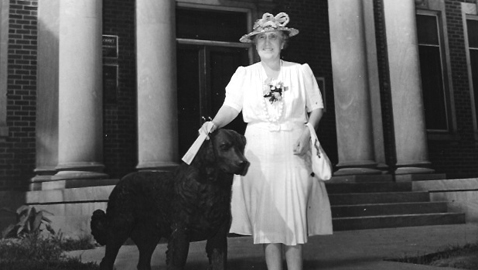 Camille Kelley, Judge of the Shelby County Juvenile Court, 1940
Camille Kelley, one of the most prominent members of the Crump machine, would go from national recognition to a suspect in one of the most despicable and lurid scandals in Tennessee history.
Born the daughter of a physician and like many at the time, coy about her actual age, Camille McGee attended medical school for a couple of years before she chose to marry a successful attorney, Thomas Fitzgerald Kelley. Her husband had died by the time she ascended the bench in 1920. Camille Kelley was not a lawyer, but she seemed like a good choice to serve as Judge of the Juvenile Court, at least to Edward Hull Crump, master of the Memphis political machine. Crump and his political ally, Senator Kenneth D. McKellar, were strongly in favor of rights for women, which meant the entire machine favored increased rights for women. Crump and especially McKellar worked hard to give women the right to vote in Tennessee.
It was just after Tennessee ratified the Nineteenth Amendment to the Constitution that Camille Kelley became Judge of the Shelby County Family Court. It allowed the Crump machine to appear progressive and compared to most political organizations, especially in the South, it was. The Memphis Boss had cobbled together virtually every aspect of Memphis’s social life to comprise his political machine. Business, labor, public employees all played important roles in the machine, which extended to the PTA and beyond. Several high ranking members of the Crump machine were Jewish, notably Will Gerber and Abe Waldauer; Crump even encouraged African-Americans to vote, a fact which frequently outraged the machine’s opponents. As judge of the Family Court, Camille Kelley was not only a demonstration the machine was progressive, but believed in the ability of women to serve in office. Judge Kelley herself commented that women really belonged in the home rather than elective office, but she remained on the bench for thirty years and only resigned when details of a sordid public scandal began to emerge.
As one of the few women in America to serve as a judge, Camille Kelley attracted national attention. Kelley delighted in sharing her opinions about child rearing and just about everything else, which were usually in the form of homilies. Never wearing a robe into her courtroom, Judge Kelley explained, “Robes would scare the children to death.” Kelley went on to explain the corsage pinned to her breast: “They’re not so timid when they see that I am wearing a flower.”
Eventually, Judge Kelley would publish three books chock full of her opinions, witticisms, and advice. The first, “A Friend In Court,” was published in 1942. Five years later, the judge penned “Delinquent Angels,” followed by Kelleygrams in 1949.
Kelley’s grandmotherly appearance, despite her love of fine clothes, furs and flowers, made her seem anything but threatening. Despite her lack of formal education, Judge Kelley was clever in her understanding of public relations. Following her original appointment to the bench, Camille Kelley was routinely elected by the people of Shelby County on the Crump ticket. Unlike some of her ticket-mates, Kelley was so popular, she rarely ever had opposition.
Jennifer Ann Trost has written an interesting book, “Gateway to Justice: The Juvenile Court and Progressive Child Welfare In A Southern City,” which contains much information about Camille Kelley.
Ms. Trost points out the Shelby County Family Court “cannot be understood without examining the life and ideas of its chief judge, Camille Kelley. So much of what the juvenile court was and subsequently became was defined by her philosophy and personality.”
As Ms. Trost points out, Camille Kelley was quite contradictory about her own role, as well as that of other women in public life. Kelley opined, “No woman should enter public life if it makes her less a woman, for there is no height to which she may climb equal to real home making or wifehood or motherhood.” Yet Judge Kelley acknowledged the need of many families for two incomes and she staunchly defended the right of women to work outside the home, but Kelley also excoriated many working mothers for neglecting their responsibilities at home.
“A mother in the home is of greater value to a child than money in the bank,” was Judge Kelley’s lofty opinion.
Apparently Camille Kelley had fixed opinions about most everything and never doubted her own wisdom. Kelley believed girls were more difficult than boys and one Memphis newspaper told its readers, “Nor does a boy have to be a ‘sissy boy’ to be a good boy – – – in fact Judge Kelley doesn’t care for ‘sissy boys’. She likes boys who are manly, boys who are ‘reg’ler fellers’.”
Although some black youngsters complained of harsh treatment while in the custody of the Shelby County Family Court, Ms. Trost notes Judge Kelley did not attempt to mete out different or harsher punishments to African-American children than she did to white youngsters. In fact, Camille Kelley apparently sought to better conditions for African-American children. Ms. Trost writes, “For her, the condition of childhood necessitated protecting black children as well as white children.”
Judge Kelley believed “love is the modern way to educate children” and frowned upon parents spanking children, declaring it to be not “the scientific, advanced method” of discipline in the home. To say the least, that was quite a progressive view at the time.
Being one of the very few female judges in the country, Camille Kelley drew considerable attention not only in Memphis, but nationally. Judge Kelley was the recipient of several national awards and was regularly invited to appear on radio and television programs. By the time she resigned in 1950, Camille Kelley’s service on the bench was fodder for a Hollywood production company which intended to produce both a movie and a television series about her work.
Although certainly a member of the Crump machine, the Memphis Boss was content to let Kelley rule her own domain. Kelley herself boasted her court was untouched by politics. Judge Kelley
condescendingly stated she did not participate in the sordid political arena, opining that women should not “supplant the men in public jobs they have held for hundreds of years. Women are capable, of course,” she added, “but we can’t spare them. We need them to concentrate on child welfare and education, work we are inherently better fitted to do than men.”
When she was finally forced out of office, Judge Kelley told the mayor, “No political interference has ever touched the inside of my courtroom, so help me God.” That was not entirely true.
As Jennifer Trost describes in her book, one of Judge Kelley’s trusted aides was fired at the insistence of one of Memphis’s City Commissioners. The public perception of Judge Camille Kelley was such that local newspapers roared their collective fury at the offending City Commissioner with blaring headlines demanding “Hands Off Judge Kelley’s Court” and “Free the Juvenile Court of Interference.”
The official fired from the court was Beulah Wood Fite who was the chief probation officer for the Shelby County Family Court. The working relationship between Judge Kelley and Ms. Fite was apparently quite close, as after Kelley was widowed, Ms. Fite moved into the judge’s home. Another employee from the juvenile court, one Altye Barbour, who presided over the mental exams given the children, also moved into Judge Kelley’s home.
Fite was evidently well liked by many of the children whom she encountered in the course of her professional life and was generally referred to as “Mamma”. Unfortunately for Ms. Fite, she was less well liked by some of the adults she worked with. Ms. Fite was not above chastising anyone she believed to have made a mistake, which extended to other officials. Described as having a “brusque” personality and regularly scolding parents whom she felt had done less than a stellar job with their children, Ms. Fite’s forceful personality caused her to run afoul of the City Commissioner who demanded she be fired. A serious flood in 1937 caused the Memphis Red Cross to request children in the custody of the juvenile court to be moved to a location it considered safer. Ms. Fite arbitrarily rejected the request, which caused the City Commissioner to demand the Juvenile Court Advisory Board to dismiss her immediately.
Jennifer Trost writes that “Kelley was strangely silent about losing one of the best-qualified members of her court.” Yet there is an explanation for Judge Kelley’s silence. It is difficult to imagine any member of the City Commission to have demanded Ms. Fite’s resignation without the express consent of Mr. Crump. Memphis and Shelby County was E. H. Crump’s domain and it is not hard to believe the Memphis Boss would have been less than amused by a minor official haughtily rejecting a request by the Red Cross. Had Crump sanctioned Ms. Fite’s dismissal, Judge Kelley would have had nothing to say about it, realizing to cross the Memphis Boss would imperil her own continued tenure at the court. Camille Kelley was too experienced and too shrewd to think she could countermand an order from Boss Crump.
Written By: Ray Hill
Source: knoxfocus.com
Judge Camille Kelley

Camille Kelley. This portrait that hangs in the Shelby County Juvenile Court building in Memphis, TN.
Camille McGee Kelley (1879–January 28, 1955) was an American juvenile court judge and author. She was investigated by the state of Tennessee for using her judgeship to aid Georgia Tann's ongoing adoption fraud operation conducted under the auspices of the Tennessee Children's Home Society and resigned shortly after this information became public.
History
Camille Kelley was the juvenile court judge in Shelby County, Tennessee from 1920 to 1950. Known as the "Little Irish Judge," she never wore a judicial robe in court, opting instead for colorful dresses, jewels and always a flower pinned to her shoulder. She was quoted as saying, "Robes would scare the children to death. They're not so timid when they appear before me and see that I am wearing a flower".
Kelley's formula in dealing with delinquents was simple: "We try the boy, not his offense. We seek to take away from him nothing but his mistakes." She was often quoted as saying that juvenile justice should be tempered with a sympathetic understanding of human problems. Shortly after she retired, she said favorable results were obtained in 85-90% of the 50,000 cases that she had handled.
Kelley authored three books inspired by her experiences at juvenile court.
Scandal
Hallmark Productions was producing a movie based on her book, Delinquent Angels, but suspended production after her resignation from the bench in November 1950, in a storm of controversy and charges after the results of a special investigation ordered by Governor Gordon Browning were released.
The investigation surrounded illegal adoptions-for-profit by Georgia Tann and the Tennessee Children's Home Society. It charged that approximately 20% of the illegal adoptions at the home were funneled through Kelley's court, where she would remove parental rights and provide Tann with documents to place the children as she deemed appropriate. Kelley was never prosecuted for any crimes associated with the home. She died at her son's home over four years after the scandal first broke, from complications due to a stroke.

Judge Kelley with a child in her court room. Notice the famous Tiffany Stained Glass Window behind her.
Publications
- A Friend in Court (Dodd, Mead & Company, 1942)
- Delinquent Angels (Brown-White-Lowell Press, 1947)
- Kelleygrams (Self-published, 1949)
Sources
- Report to Governor Gordon Browning on Shelby County Branch, Tennessee Children's Home Society. 1951, [Nashville] : State of Tennessee, Dept. of Public Welfare.
Birth:
| Oct. 13, 1879 Trenton Gibson County Tennessee, USA | |
| Death: | Jan. 28, 1955 Little Rock Pulaski County Arkansas, USA |
 Author, Juvenile Court Judge. She wrote three books regarding handling problem children in the juvenile court system, "Kellygrams" , "A Friend in Court" and "Delinquent Angels". She was the Juvenile Court Judge in Shelby County, Tennessee from 1920 to 1950. Known as the "Little Irish Judge", she never wore a robe in court, opting for colorful dresses, jewels and always a flower pinned to her shoulder. She was quoted as saying "Robes would scare the children to death. They're not so timid when they appear before me and see that I am wearing a flower". Her formula in dealing with delinquents was simple: "We try the boy, not his offense. We seek to take away from him nothing but his mistakes". She was often quoted as saying that juvenile justice should be tempered with a sympathetic understanding of human problems. Shortly after she retired, she said favorable results were obtained in 85 to 90 percent of the 50,000 cases she had handled. Hallmark Productions was producing a movie based on her book, "Delinquent Angels", but suspended production after her resignation from the bench in November, 1950, in a storm of controversy and charges after the results of a special investigation ordered by Governor Gordon Browning of the State of Tennessee was released. The investigation surrounded illegal adoptions-for-profit by Miss Georgia Tann and the Tennessee Children's Home Society. It charged that approximately 20% of the illegal adoptions at the home were funneled through Kelley's court, where she would remove parental rights and provide Tann with documents to place the children as she deemed appropriate. Judge Kelley was never prosecuted for any crimes associated with the home. She died at her sons home, Little Rock Arkansas attorney Heiskell Kelley, after complications due to a stroke. Family links: Parents: John Preston McGee (1835 - 1890) Virginia Candace Elder McGee (1844 - 1889) Spouse: Thomas Fitzgerald Kelley (1873 - 1928) Children: Heiskell B. Kelley (1904 - 1979)* Thomas Fitzgerald "Gerald" Kelley (1906 - 1939)* Evelyn Camille Kelley (1910 - 1922)* Siblings: Howard Hawthorne McGee (1867 - 1895)* Babbington McCauley McGee (1869 - 1926)* Genevieve McGee McGehee (1871 - 1897)* Camille McGee Kelley (1879 - 1955) *Calculated relationship | |
| Burial: Forest Hill Cemetery Midtown Memphis Shelby County Tennessee, USA Plot: Section 11, Plot 138 | |
Created by: Neil Loftiss Record added: Jun 25, 2009 Find A Grave Memorial# 38731655 | |
Source wikipedia.com
Georgia Tann

Georgia Tann (July 18, 1891 – September 15, 1950), born Beulah George Tann, was an American child trafficker who operated the Tennessee Children's Home Society, an adoption agency in Memphis, Tennessee. Tann used the unlicensed home as a front for her black market baby adoption scheme from the 1920s until a state investigation into numerous instances of adoption fraud being perpetrated by her closed the institution in 1950. Tann died of cancer before the investigation made its findings public.
Illegal activities
Tann used pressure tactics, threats of legal action and other methods to take children from their birth parents, mostly poor single mothers, and sold them to the wealthy patrons. Tann also arranged for the taking of children born to inmates at Tennessee mental institutions and those born to wards of the state through her connections.Tann also arranged for what her victims (now adult) refer to as kidnapping. In some cases, single parents would drop their children off at nursery schools, only to be told that welfare agents had taken the children. In others, children would be temporarily placed with the society because a family was experiencing illness or unemployment, only to find out later that the Society had adopted them out or had no record of the children ever being placed. Tann was also documented as taking children born to unwed mothers at birth, claiming that the newborns required medical care. When the mothers asked about the children, Tann told them that the babies had died, but they were actually placed in foster homes or adopted.
Tann's crimes were accomplished with the aid of Memphis Family Court Judge Camille Kelley, who used her position of authority to sanction Tann's tactics and activities. Tann would identify children as being from homes which could not provide for their care, and Kelley would push the matter through her dockets. Kelley also severed custody of divorced mothers, placing the children with Tann, who then arranged for adoption of the children into "homes better able to provide for the children's care". However, many of the children were placed into homes where they were used as child labor on farms, or with abusive families.
When an adoptive parent discovered that the information on the child was incorrect, such as in cases of falsified medical histories, Tann often threatened the adoptive parents with possible legal action that would force a surrender of their children (ordered by Kelley) by demonstrating that they were unfit parents.
Tann destroyed records of the children that were processed through the Society and conducted minimal background checks on the adoptive homes. Many of the files of the children were fictionalized before being presented to the adoptive parents, which covered up the child's circumstances prior to being placed with the society. As a result, the Child Welfare League of America dropped the Society from its list of qualifying institutions in 1941.
The Georgia Tann/Tennessee Children's Home Society scandal resulted in adoption reform laws in Tennessee in 1951.
Out-of-state adoptions
Under Tennessee law at the time, the Home charged about $7 per adoption. Adoptions in states such as Mississippi, Arkansas and Missouri could be arranged for $750.However, Tann also had arranged for out-of-state private adoptions where she charged a premium, upwards of $5,000 per child, for her "services". It is alleged that she pocketed 75% of the fees from these adoptions for her own personal use and failed to report the income to either the Society Board or the Internal Revenue Service.
The Tennessee Children's Home Society was closed in 1950 and is not to be confused with the current Tennessee Children's Home, which is accredited by the state of Tennessee. This Tennessee Children's Home has no legacy connection with Georgia Tann or the Society which she operated.
Tann made millions selling children, 90% to New York and California. New York and California vowed to take action, but the children's adoptions were never investigated, no children were restored.
Notable personalities who used Tann's services (but were not aware of the tactics used by Tann to acquire many of the children processed through the Tennessee Children's Home Society) included actress Joan Crawford (daughters Christina Crawford, and twins Cathy and Cynthia were adopted
through the agency). June Allyson and husband Dick Powell also used the Memphis-based home for adopting a child, as did the adoptive parents of professional wrestler Ric Flair and New York Governor Herbert Lehman, who signed a law sealing birth certificates from New York adoptees in 1935. New York State Adoptee Equality is working to undo the #TannLehmanLegacy.
In popular culture
The scandal was also the subject of two made for television films:- Missing Children: A Mother's Story (1982) (TV) at the Internet Movie Database (1982)
- Stolen Babies (1993) (TV) at the Internet Movie Database (1993)

See also
Sources
- Barbara Raymond. The Baby Thief: The Untold Story of Georgia Tann, the Baby Seller Who Corrupted Adoption. 2007. 320p. Carroll & Graf.
- PROFILE: Mary Margulis St. Louis Post - Dispatch St. Louis, Mo.: May 10, 1993. p. 1 Section: EVERYDAY MAGAZINE
- Report to Governor Gordon Browning on Shelby County Branch, Tennessee Children's Home Society. 1951, [Nashville] : State of Tennessee, Dept. of Public Welfare.
Birth:
| Jul. 18, 1891 Philadelphia Neshoba County Mississippi, USA | |
| Death: | Sep. 15, 1950 Memphis Shelby County Tennessee, USA |
Black Market seller of children for profit. Georgia Tann (Born: Beulah George Tann) became the director of the Memphis Chapter of the Tennessee Children's Home Society in 1927. Through trickery, deceit and outright fraud, she stole children from parents through a variety of sources such as baby scouts, corrupt Judges and even more corrupt politicians. She placed over 5,000 children all over the country, many of them to Jewish families in New York, and to stars in California. Birth certificates were rewritten to make the children's background fit the desires of prospective parents. This included taking Christian children and giving them Jewish sounding names. Other records were destroyed, to cover the tracks of the Orphanage and their criminal acts of kidnapping. Children were often taken from their mothers under the pretence of seeking medical care. The mothers were later told their children died, and had been buried without notification. Many newborns were taken, and their mothers told they had been stillborn, and the bodies had been removed to lessen their grief. Children were placed without consideration of the stability of the families they were going to. Some were adopted as servants and farmhands, some to pedophiles for sexual abuse, while some lucky ones were adopted into a life of privilege and wealth. Tann ran ads in newspapers throughout the country with captions like "Want a real, live Christmas present?" Children would be delivered throughout the country by her workers, or her lesbian lover, partner and adopted daughter, Ann Atwood Hollinsworth , who 'volunteered' at the Tennessee Children's Home Society. Edward Hull "Boss Crump" Crump was the political clout behind Georgia Tann. He wielded great power and influence in Memphis, and throughout Tennessee. He would send his cronies to handle any ‘disputes', and use his influence to change laws to fit the needs of Georgia. Abe D. Waldauer Assistant City Attorney under Crump (also Georgias' personal attorney, and Chairman of the Tennessee Childrens Home Society), would rewrite laws to cover Georgias tracks. She contributed generously to Boss Crumps campaign coffers. Juvenile Court Judge Camille Kelly provided an estimated 20% of the children Georgia placed. Judge Kelly would use the court to remove parental rights, and to give Georgia the necessary documentation to take children and place them as she wished. Later inquiries estimated that upward of 500 children that were not "easy to adopt", died, mostly through starvation and neglect. Many of their bodies have never been found. It is estimated that Tann made millions of dollars through trafficking children. "Fees" for her services ran between $750 and $5,000 each. Famous people who used Tanns services (who most likely were not aware of the history or tactics of Georgia Tann) include: * Joan Crawford (Daughters Christina author of "No Wire Hangers", and twins Cathy and Cynthia came from Tann) * June Allyson and husband Dick Powell. * Actress Lana Turner * The parents of Professional Wrestler, Ric Flair * Governor Herbert Lehman of New York. * Mobster Frank ‘The Enforcer' Nitti and his wife adopted their son, Joseph, from Tann. Mary Tyler Moore won an Emmy award for her portrayal of Tann in the television movie, "Stolen Babies," 1993. Tann died of cancer (Carcinosis, primary location uterus, according to Dr. Alma Richards on death certificate) on September 15, 1950, three days before Governor Gordon Browning of Tennessee filed charges against Tanns home. The home was permanently closed in December, 1950. ___________________________________________ Her Obituary Services for Miss Georgia Tann, who had headed the Memphis branch of the Tennessee Children's Home Society for 26 years, will be held at 4 p.m. today at National Funeral Home. The Rev. James Watson, pastor of Whitehaven Presbyterian Church, will officiate. Burial will be at Hickory, Miss, her former home, tomorrow at 2:30, accompanied by services at the grave. The veteran social worker died at her home at 91 Stonewall at 4:20 a.m. yesterday after a long illness, which had confined her to bed since last Easter and which had become critical in the past few days. Death was due to cancer. She was 59. Miss Tann, who had operated the Tennessee Children's Home Society in Memphis since 1924, during which time she had placed more than 5,000 babies for adoption was recognized as a national authority on adoption laws. Under her direction, the Memphis agency became one of the best known of its kind in the United States. She was the author of several magazine articles on the subject. Born at Hickory, Miss., she was a daughter of the late George C. Tann, chancellor of the Second District of Mississippi for 27 years. The interest that her father took in orphans and foundlings, through the operation of his court, led her into child welfare work. She was engaged in this in Mississippi and Texas before moving to Memphis. Among the first children she placed ware a small brother and sister, ages 9 and 5. They were adopted into the same home. Miss Tann related recently that the girl, now grown, has a degree in music and that the boy has finished his law school courses and had begun practicing. Four years ago she estimated that up to that time she had placed 5,000 children for adoption. While she kept no record of the subsequent total, the number is believed to run into the hundreds. Miss Tann was educated at Martha Washington College in Virginia and took social courses at Columbia University, New York for two summers. Her father desired to make a musician of her and she took an extended piano course, but her interest in children turned her to another career. Once Miss Tann was asked how adopted children turn out. "The answer is" she replied, "That 100 of our children turn out, on the average, much better than 100 picked from homes at random. The reason is that ours is a selective process. We select the child and we select the home. "The Organization keeps up with the child until it is 21 years of age, but the dealings are with the foster parents. We try to let the children forget. We stand in the background, ready to help if difficulties arise but never impressing it on the child that he is adopted." Miss Tann said girls whom she has placed for adoption, and who had grown up and married, often come to show her their babies and even their grandchildren. Miss Tann was a strong advocate of homeless children being adopted into private homes, instead of being placed into orphanages or similar institutions. In her testimony before a Tennessee Legeslative Committee hearing at Nashville in 1947, when proposed changes in the state's Adoption Law were being discussed, Miss Tann declared there were more than 30 homes seeking babies for adoption for every baby available for adoption. "Why are so many children kept in institutions at a cost to the taxpaying public of $10 or more a week?" she asked, illustrating her contention. Miss Tann had placed infants for adoption in many states, some far distant from Memphis. "It is better for the children for them to grow up in another city where there will be little or any possibility of interference by their former parents who have given them up" she once told a reporter. "They are beginning a new life in a new home and should not be molested." Miss Tann leaves am adopted daughter, Mrs. June Tann Watson of Brandon, Miss; her mother, Mrs. Beulah J Tann of Hickory, an adopted sister, Mrs. Ann Hollinsworth of Memphis and a niece, Mrs. Beulah Elizabeth Tann Burns of Newark, N.J. The Commercial Appeal, September 16, 1950 _______________________________________ By Lois Cooper The story of Georgia Tann is one of intrigue, fascination, horror, disbelief and many more words of description. It is a story of a very influential woman who was born and raised in Hickory, Mississippi. She achieved a position of outstanding prominence. Her life was one of fraternizing with the elite. Eleanor Roosevelt sought her counsel regarding child welfare. Pearl Buck asked her to collaborate on a book about adoption. She received a personal invitation to President Truman's Inauguration. She traveled in politically elite circles. And, while doing all of this, she visited with her mother often in Hickory. The beautiful Tann home, which is the second oldest home in Hickory, is located near Highway 503. There are residents in the home today and the home still has visions of grandeur. Georgia Tann is buried in the Hickory Cemetery along with her parents, George Clark Tann and Beulah Yates Tann, and her brother, Rob Roy Tann. It is a very nice Tann burial plot. Standing over Georgia's grave in the Hickory Cemetery, the average person would never know the controversy she stirred up during her lifetime. She had one of the largest black markets for children ever seen in the United States. From 1924 to 1950, Georgia Tann stole, or otherwise separated, more than 5,000 children from their families. Louise Bailey and I have long been interested in the Georgia Tann story and, in 2009, conducted extensive research on her activities using both primary and secondary sources as well as many interviews. A major source of information came from the book The Baby Thief by Barbara Raymond. The television movie, "Stolen Babies," was released in 1993 with Mary Tyler Moore portraying Georgia Tann. Articles on Tann's life also have been published in Good Housekeeping magazine. The Meridian Star did an article on Georgia Tann on March 25, 1993. Georgia Tann also gained national media attention on television series such as "Unsolved Mysteries" and "Probe." We do not know much about Georgia's young years in Hickory. Georgia's father was the most influential person in her life. Her feelings toward him were a mix of love and hate, or wanting to prove herself to him and to defy him. Georgia's parents were Judge George Clark Tann and Beulah Yates Tann. George Clark Tann's grandfather had served under William Henry Harrison at the Battle of Tippecanoe and his father was a Confederate war hero. George himself was the most educated man in Newton County and Judge of the Mississippi Second Chancery District Court. While George was respected, he was not well liked for he was arrogant, argumentative, and domineering. Georgia had a brother, Rob Roy Tann, who was three years older. While serving in World War I, he suffered what was then called shell shock and for the rest of his life suffered from tremors. He died of tuberculosis at age 46. Georgia majored in music and, after graduating in 1913 from Martha Washington College in Abingdon, Virginia, she taught school briefly in Columbus, Mississippi. However, she lacked the patience for teaching and may well have considered it an old-fashioned profession. Georgia was also familiar with social work, at that time in its infancy, having long practiced a form of it herself. Charity work was a refuge during her adolescence, perhaps providing an excuse for her absence from local parties and dances. While other girls primped for the parties, she put on starched, long-sleeved blouses and skirts that swept the floor and visited the local poor. By 1920, exploiting the lack of regulations on adoption and her father's position as a judge, Tann began placing children she had kidnapped from poor women. Georgia began working for Kate McWillie Powers Receiving Home for Children in Jackson which was affiliated with the Mississippi Children's Home Society. Georgia was run out of Mississippi for her "child-placing" methods and went to Texas. Georgia then moved to Memphis, TN. She became Executive Director of the Memphis branch of the Tennessee Children's Home Society. Barbara Raymond said in her book, The Baby Thief, "Scores of children in the custody of Tann's Tennessee Children's Home Society died, making Memphis' infant mortality rate the highest in the country. Yet Tann was publicly lauded for her work. She also amassed a personal fortune selling children to the wealthy (including actors June Allyson, Dick Powell, and Joan Crawford). Virtually no robbed parents got their children back." There seemed to be no end to the pain that Georgia caused. While building her black market business, she had invented modern American adoption. To cover her kidnapping crimes, she falsified adoptees birth certificates, issued false certificates, and portrayed their adoptive parents as their birth parents. In 1950, the Tennessee Governor finally acknowledged Georgia's crimes. The adoptive parents could not bring themselves to investigate whether their children had been stolen for fear of having to return them. Georgia had many accomplices: Politicians, legislators, judges, attorneys, doctors, nurses, and social workers who scouted child victims. She operated for 26 years. It was not until she was three days from death with cancer that a Tennessee official told of her crimes. If the story of Georgia Tann teaches us anything, it is the importance of ridding adoption of lies and secrets. Thankfully, much as been done since Georgia's death to help parents find children through well respected adoption agencies. From The Newton County (MS) Historical and Genealogy Society, http://www.nchgs.org, written by Lois Cooper, August 8, 2010. ___________________________________________________ Camille McGee Kelley, judge of the Shelby County Family Court, was a jewel in the crown of the Memphis machine of Edward Hull Crump. At the time of her appointment in 1920, Kelley was only one of two female judges in the South and the only woman to sit as a juvenile court judge. Kelley was highly popular in Memphis and Shelby County, an easily recognizable figure in her trademark dresses, furs and a large flower always pinned to her chest. Kelley looked precisely like what she was: a friendly, well-to-do grandmother who was somewhat smug and condescending in freely dispensing her maternal wisdom to anyone who would listen. The Memphis Boss was always highly sensitive to the attacks of opponents on his political machine and Crump countenanced no graft or corruption from his subordinates. At the first hint of corruption, Crump moved with alacrity in removing the offender from office. Yet the reign of the matronly juvenile court judge would prove to be one of the worst cases of corruption in modern Memphis history and a sore embarrassment to Crump. One cannot detail the life and service of Judge Camille Kelley without relating the history of Miss Georgia Tann, who operated the Tennessee Children's Home Society. Miss Tann would have a powerful, albeit malevolent, influence upon adoption of children. Like Judge Camille Kelley, Miss Georgia Tann had a matronly and benign appearance and no less than First Lady Eleanor Roosevelt believed her to be an expert in the field of childcare. Perhaps no one in the State of Tennessee had more to do with the confidentiality laws adopted by the General Assembly than Georgia Tann. Miss Tann used those laws to her advantage and apparently destroyed, altered or otherwise tampered with birth records to the extent where it became impossible to determine the parentage of thousands of children. Miss Georgia Tann turned adoption into a money-making enterprise and at a time when adoptions in Tennessee cost the princely sum of $7, some adoptions brokered by Tann cost as much as $5,000, roughly the equivalent of $84,000 in today's currency. Miss Tann operated her Tennessee Children's Home Society before the extensive welfare state existed in this country; there was little in the way of support, financial or otherwise, single mother's could count on at the time. Crump's Memphis was well run and Memphis won numerous awards for its cleanliness, safety, etc., yet one statistic likely vexed the Boss; it had the highest infant mortality rate in the country. Miss Georgia Tann was born in 1891, the daughter of a judge in Mississippi. Georgia was a nonconformist at an early age, altering her name from Beulah George Tann to the more feminine "Georgia." Georgia was not an especially attractive woman and she displayed little interest in settling down and marrying. Instead, Georgia Tann pursued one of the few avenues available to women who wished to become professionals in that era: social work. It not only afforded Georgia the opportunity for a career, but a means to escape from her home and her domineering father. Miss Tann rapidly concluded poor people could not possibly be fit parents. Her comments about poor people having children were both cruel and derisive; Miss Tann referred to them as "breeders" and the mothers as "cows." When Miss Georgia Tann embarked upon her unfortunate career, adoption was hardly a common practice. She would refine it to an art form and one that paid handsomely. Miss Tann was hired by the Mississippi Children's Home-Finding Society and she began finding homes for children, but soon discovered there were men and women who were nothing less than desperate to have a child and they were willing to pay. Miss Tann visited the home of a poor young widow named Rose Harvey, who lived in a cabin in Jasper, Mississippi. Rose was ill, suffering from diabetes, and pregnant. Her two-year old son, Onyx, was playing on the porch when Georgia Tann arrived and took the little boy. Rose's father was convinced to sign legal documents stating his daughter was an unfit mother and had abandoned Onyx. The brown-haired, brown-eyed little boy was given to another family and even though Rose managed to hire an attorney, she could not get her child back. It was that same year that Georgia Tann adopted a child herself; Miss Tann adopted a baby girl whom she named June. Quoted in Barbara Raymond's book about Miss Georgia Tann, June's daughter Vicci said, "Mother said Georgia Tann was a cold fish; she gave her material things, but nothing else. I don't why she bothered to adopt her." By 1924, Miss Georgia Tann was in Memphis, Tennessee and started the Tennessee Children's Home Society. In time, some of the wealthiest couples in the country would adopt babies from Georgia Tann. Several movie stars adopted babies from Miss Georgia Tann, including Joan Crawford, Lana Turner, and Dick Powel and his wife, June Allyson. Governor and Mrs. Herbert Lehman adopted a baby from Georgia Tann; Lehman was the lieutenant governor to Franklin D. Roosevelt and FDR's successor. He was also enormously wealthy, being the heir to Lehman Brothers. Georgia Tann owned considerable property and purchased a home in Memphis at 91 Stonewall Street, a comfortable bungalow type structure of some 2,200 square feet, three bedrooms and two baths. Miss Tann lived there with her partner, Ann Atwood Hollinsworth. Tann officially adopted Mrs. Hollinsworth in Dyer County a few years before her death. Mrs. Hollinsworth had a son, Jack, who was killed in an American Airlines plane crash in 1943. Mrs. Hollinsworth would outlive her partner by almost fifty years, dying in 1995. Once a baby was in Miss Tann's custody, she would alter the birth records beyond all recognition and create a more acceptable story accounting for the baby's birth, which was calculated to appeal to prospective adoptive parents. Rather than simply being the child of a single mother or poor couple, the baby was the result of a brief union between a young mother of good breeding and her boyfriend of equally social standing. Miss Tann was not above creating a background for a particular child to suit prospective adoptive parents. Georgia Tann's personal appearance likely actually aided her in concealing her true nature. A rather dumpy woman, who usually looked rather rumpled, looked like anything save for the aristocrat she pretended to be. Her graying hair was cut short and seemed only haphazardly styled. Miss Georgia Tann looked quite innocuous; she did not seem in any way threatening. She appeared to be an inoffensive middle-aged woman and likely looked precisely like what many perceived to be a professional social worker. Miss Tann, for all her faults and loathsome nature, was quite shrewd. She employed Abe Waldauer, a high-ranking member of the Crump machine, as her attorney. In Memphis, Waldauer was extremely well connected and he proved to be an effective ally in lobbying the Tennessee General Assembly. Waldauer was sympathetic to Miss Tann, as he was an adoptive father himself. Miss Tann's first contact with Abe Waldauer seems to have been in 1933 when she wanted the lawyer's help with her invalid brother. Georgia Tann wrote a petulant letter to Waldauer on January 28, 1933, complaining, "I have tried several times recently to see you and talk with you in regard to my brother's claim against the government." Eventually Waldauer became both Georgia Tann's personal attorney as well as that of the Tennessee Children's Home Society. The Board of the Tennessee Children's Home Society included some of the "best" people in Memphis; Walter Chandler would go on to serve as Congressman from the district, as well as Mayor of Memphis. John Reichman was a former Shelby County sheriff and Mrs. E. W. Hale was the wife of the head of the Shelby County Commission. The famous author Pearl Buck even wished to collaborate on a book with Georgia Tann. Yet some suppose E. H. Crump knew exactly what Miss Tann was doing and she somehow enjoyed his personal protection. It seems unlikely she fooled practically everybody save for Boss Crump. And Miss Georgia Tann had a lot of people fooled. Georgia Tann helped to formulate the laws on adoption in Tennessee, some of which exist to this day. Due to the nature of her business, it was imperative to Miss Tann that adoption records remained confidential and closed. Miss Tann was quite secretive and there appear to be instances where she even deceived her own lawyer. Georgia Tann would contact Judge Kelley with a list of changes in Tennessee's laws which she believed needed to be changed. Judge Kelley would then send the list on her own stationery to Abe Waldauer, giving Waldauer the notion those changes were requested by Judge Kelley and the Shelby County Family Court. Many of the children given up or sold for adoption by Miss Georgia Tann were fortunate enough to find loving homes, but there were many who were far less lucky. There were numerous stories of birth parents and mothers who literally spent their entire lives trying to locate their lost children. Miss Tann conceived the idea of placing ads in local newspapers, complete with a photograph of a child well scrubbed and nicely dressed under the headline, "Want A Real Live Christmas Present?" Another featured a smiling little boy grasping a ball under the headline, "Yours for the Asking!" The advertisement, which ran in the Memphis Press Scimitar on December 8, 1935, read: "Yours for the asking! "George wants to play catch but needs a Daddy to complete the team. ‘Catch this ball, Daddy!' How would YOU like to have this handsome five-year old to play ‘catch' with you? How would you like his chubby arms to slip around your neck and give you a bear-like hug? His name is George and he may be yours for the asking, if you hurry along your request to the Christmas Baby Editor of the Press-Scimitar. "In cooperation with Miss Georgia Tann of the Tennessee Children's Home Society, the Press-Scimitar will place 25 babies for adoption this Christmas." Even the local newspapers believed they were rendering a real service to the children by finding them loving homes. Like Judge Kelley, Miss Georgia Tann was actually lauded by an unsuspecting population for what most believed to be her good work. National publications referred to her as "the foremost leading light in adoption laws" in the country. Eleanor Roosevelt actually sought Miss Tann's advice on issues regarding child welfare and President Harry Truman invited her to his inauguration. If anything, Miss Georgia Tann was outwardly respectable. Miss Tann's alliance with Judge Kelley gave her enormous power. Armed with not only the power of the court, Miss Tann had the resources at her command from the Memphis Police Department and the Shelby County's sheriff's office through Judge Kelley. There is good reason to believe Judge Kelley was paid by Miss Georgia Tann for her cooperation. By the 1940s, some uncomfortable questions were being asked. Miss Tann owned considerable property, including a motel, a large farm and home named "Tannwood" and was driven about town in a chauffeured Cadillac limousine. Evidently folks were encouraged to believe Georgia Tann came from a prominent and wealthy Mississippi family, so fewer eyebrows were raised than might have been the case otherwise. Very few social workers had the means to employ a chauffeur who actually wore a uniform. The Crump machine suffered devastating defeats in the 1948 elections. Crump refused to support Senator Tom Stewart for reelection that year, preferring instead to back Cookeville Judge John A. Mitchell, whom the Memphis Boss had never even met. Crump's political partner, Senator K. D. McKellar, tried to change Crump's mind, but was unsuccessful. Senator McKellar did not believe Judge Mitchell was a strong candidate, a reality that became more abundantly clear as the Democratic primary approached. Both McKellar and Crump were backing incumbent Jim Nance McCord for the gubernatorial nomination in 1948, but Governor McCord was mortally wounded by having instituted a sales tax for education. Tennesseans apparently less appreciated the free textbooks for their children than they resented the new tax. McCord was opposed by former Governor Gordon Browning, a long-time opponent of both Crump and McKellar. The election of Gordon Browning and Estes Kefauver in the Senate race ended the long domination of Tennessee politics by Senator McKellar and E. H. Crump. The whispers surrounding Miss Georgia Tann's Tennessee Children's Home Society soon reached the ears of Governor Browning. The governor realized were the allegations true, it would be a profound embarrassment to Crump and his machine. Browning authorized an investigation and announced the findings at a press conference. They were both appalling and devastating. The focus of Governor Browning's comments had less to do with the children, their parents or the theft of babies than profiteering illegally while the Tennessee Children's Home Society received state funding. Browning's choice to lead the investigation was attorney Robert L. Taylor (later for years a federal judge sitting in Knoxville) who termed many of the adoptions by Georgia Tann as "mail order adoptions". Taylor's report revealed some judges in Memphis had urged that the Tennessee Children's Home Society be investigated years ago. Georgia Tann's operation had also been investigated by John Brown, U. S. Attorney for the Western District of Tennessee and a McKellar appointee. Brown's probe clearly indicated adoptive parents were being seriously overcharged for investigation and transportations costs. Tennessee's Commissioner of Welfare had concluded that more than 1000 babies sent to New York and California had cost the parents perhaps as much as $1,000,000, a sum roughly equivalent to approximately $9,700,000 in today's dollars. Ironically, Miss Georgia Tann was by that time outside the reach of the law. Within days of the governor's press conference, Georgia Tann died from cancer inside her home and in the comfort of her own bed. Tann died from uterine cancer and strangely had never sought any kind of treatment. Death came for her before the law could. Camille Kelley, for thirty years judge of Shelby County's Family Court, quickly announced she was resigning for reasons of health. It was readily apparent Crump had forced her resignation from the bench. Past seventy at the time, Judge Kelley also escaped prosecution, retiring quietly and living with her son, where she died from a stroke in 1955. The victims, the children adopted out to families across the country, were only granted the right to view their birth certificates and records of their adoptions by the State of Tennessee in 1995. Some were reunited with members of their families and some are still looking to this day. The Knoxville Focus, By Ray Hill, June 4, 2014   Family links: Parents: George Clark Tann (1858 - 1932) Beulah Isabella Yates Tann (1868 - 1963) Children: June Ann Tann Hawks (1921 - 1972)* Sibling: Rob Roy Tann (1888 - 1934)* Georgia Tann (1891 - 1950) *Calculated relationship | |
| Burial: Hickory Cemetery Hickory Newton County Mississippi, USA | |
Created by: Neil Loftiss Record added: Jun 12, 2009 Find A Grave Memorial# 38235660 | |
| Source: wikipedia.com and Findagrave.com | |||||||||||||
The Children Of Georgia Tann
Real Name: Beulah George "Georgia" Tann
Case: Child Abduction/Abuse/Murder
Location: Memphis, Tennessee
Date: 1920's to 1950
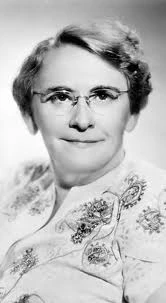
Beulah George Tann (Georgia)
From 1924 through 1950, Beulah George "Georgia" Tann ran the Tennessee Children's Home Society, from a stately home on Poplar Avenue in Memphis, TN. Tann used it as a front for an illegal foundling home and adoption agency that placed over 5,000 newborn infants and children, from toddlers up to age 16, to sell to what Ms. Tann called "high type" families in 48 states. She used manipulation, deception, pressure tactics, threats, and brute force to take children from mainly poor single mothers in a five-state area to sell to wealthy parents up until outrage, lawsuits, and complaints spurred a state investigation into her tactics closed her down in 1950. Protected by the infamous Edward Hull "Boss" Crump, she regularly altered and destroyed the records of the children "processed" through her custody and did not conduct checks on the adoption homes to which she sent children. It is believed Ms. Tann craved the wealth and power that her position and role afforded her, hopefully to eclipse her locally famous father, who was a judge in Mississippi and who had prohibited her from entering the field of law. She delivered speeches about adoption in Washington, New York, and other major cities and was consulted by Eleanor Roosevelt regarding child welfare. So many children died while in Tann's care that at one point, the infant mortality rate in Memphis, Tennessee was highest in the country and many more deaths were never reported. Notable celebrities such as Joan Crawford, June Allyson, and her husband Dick Powell, Smiley Burnette, and Pearl Buck used her services as well as the parents of New York governor Herbert Lehman. Tann's death prior to prosecution in 1950 led to more stringent laws on adoption in Tennessee in 1951. Fewer than 10% of these stolen children were ever reunited with parents or siblings due to the complicity of local and state officials such as Juvenile Court Judge Camille Kelley, who provided about 20% of the children adopted out by Tann, and difficulty finding true and accurate documentation for identification. Cindy Lou Presto was one of the children adopted by her and was reunited with her mother after thirty-two years. She was abducted by her while she was playing at a park when she was just a toddler. Two of her former children, Lynne Heinz and Nancy Turner, are looking for their birth families.
Extra Notes:
This case first aired on the December 13, 1989 episode. It inspired the movies, "Missing Children: A Mother's Story" and "Stolen Babies." The book, The Baby Thief: The Untold Story of Georgia Tann, the Baby Seller Who Corrupted Adoption, by Barbara Bisantz Raymond, was published in the U.S., Australia, and the U.K. Georgia Tann was profiled on Deadly Women.
Results:
Solved. Soon after the broadcast, Lynn was reunited with her father and two half-brothers. Nancy was also able to locate and reunite with her sister, Evelyn Routh, whom she hadn't seen in over forty years.
Links:
Source: unsolvedmysteries.wikia.com
Case: Child Abduction/Abuse/Murder
Location: Memphis, Tennessee
Date: 1920's to 1950
Beulah George Tann (Georgia)
From 1924 through 1950, Beulah George "Georgia" Tann ran the Tennessee Children's Home Society, from a stately home on Poplar Avenue in Memphis, TN. Tann used it as a front for an illegal foundling home and adoption agency that placed over 5,000 newborn infants and children, from toddlers up to age 16, to sell to what Ms. Tann called "high type" families in 48 states. She used manipulation, deception, pressure tactics, threats, and brute force to take children from mainly poor single mothers in a five-state area to sell to wealthy parents up until outrage, lawsuits, and complaints spurred a state investigation into her tactics closed her down in 1950. Protected by the infamous Edward Hull "Boss" Crump, she regularly altered and destroyed the records of the children "processed" through her custody and did not conduct checks on the adoption homes to which she sent children. It is believed Ms. Tann craved the wealth and power that her position and role afforded her, hopefully to eclipse her locally famous father, who was a judge in Mississippi and who had prohibited her from entering the field of law. She delivered speeches about adoption in Washington, New York, and other major cities and was consulted by Eleanor Roosevelt regarding child welfare. So many children died while in Tann's care that at one point, the infant mortality rate in Memphis, Tennessee was highest in the country and many more deaths were never reported. Notable celebrities such as Joan Crawford, June Allyson, and her husband Dick Powell, Smiley Burnette, and Pearl Buck used her services as well as the parents of New York governor Herbert Lehman. Tann's death prior to prosecution in 1950 led to more stringent laws on adoption in Tennessee in 1951. Fewer than 10% of these stolen children were ever reunited with parents or siblings due to the complicity of local and state officials such as Juvenile Court Judge Camille Kelley, who provided about 20% of the children adopted out by Tann, and difficulty finding true and accurate documentation for identification. Cindy Lou Presto was one of the children adopted by her and was reunited with her mother after thirty-two years. She was abducted by her while she was playing at a park when she was just a toddler. Two of her former children, Lynne Heinz and Nancy Turner, are looking for their birth families.
Extra Notes:
This case first aired on the December 13, 1989 episode. It inspired the movies, "Missing Children: A Mother's Story" and "Stolen Babies." The book, The Baby Thief: The Untold Story of Georgia Tann, the Baby Seller Who Corrupted Adoption, by Barbara Bisantz Raymond, was published in the U.S., Australia, and the U.K. Georgia Tann was profiled on Deadly Women.
Results:
Solved. Soon after the broadcast, Lynn was reunited with her father and two half-brothers. Nancy was also able to locate and reunite with her sister, Evelyn Routh, whom she hadn't seen in over forty years.
Links:
Source: unsolvedmysteries.wikia.com
Georgia Tann: A Story Of Stolen Babies
The
story of Georgia Tann is one of intrigue, fascination, horror,
disbelief and many more words of description. It is a story of a very
influential woman who was born and raised in Hickory, Mississippi. She
achieved a position of outstanding prominence. She was very wealthy and
fraternized with the elite. Her life was one of fraternizing with the
elite. Eleanor Roosevelt sought her counsel regarding child welfare.
Pearl Buck asked her to collaborate on a book about adoption. She
received a personal invitation to President Truman's Inauguration. She
traveled in politically elite circles. And, while doing all of this,
she visited with her mother often in Hickory. The beautiful Tann home,
which is the second oldest home in Hickory, is located near Highway
503. There are residents in the home today and the home still has
visions of grandeur.
Georgia
Tann is buried in the Hickory Cemetery along with her parents, George
Clark Tann and Beulah Yates Tann, and her brother, Rob Roy Tann. It is a
very nice Tann burial plot. Standing over Georgia's grave in the
Hickory Cemetery, the average person would never know the controversy
she stirred up during her lifetime. She had one of the largest black
markets for children ever seen in the United States. From 1924 to 1950,
Georgia Tann stole, or otherwise separated, more than 5,000 children
from their families.
Louise
Bailey and I have long been interested in the Georgia Tann story and,
in 2009, conducted extensive research on her activities using both
primary and secondary sources as well as many interviews. A major
source of information came from the book The Baby Thief by
Barbara Raymond. The television movie, "Stolen Babies," was released in
1993 with Mary Tyler Moore portraying Georgia Tann. Articles on Tann's
life also have been published in Good Housekeeping magazine. The Meridian Star
did an article on Georgia Tann on March 25, 1993. Georgia Tann also
gained national media attention on television series such as "Unsolved
Mysteries" and “Probe."
We
do not know much about Georgia's young years in Hickory. Georgia's
father was the most influential person in her life. Her feelings toward
him were a mix of love and hate, or wanting to prove herself to him and
to defy him. Georgia's parents were Judge George Clark Tann and Beulah
Yates Tann. George Clark Tann's grandfather had served under William
Henry Harrison at the Battle of Tippecanoe and his father was a
Confederate war hero. George himself was the most educated man in
Newton County and Judge of the Mississippi Second Chancery District
Court. While George was respected, he was not well liked for he was
arrogant, argumentative, and domineering. Georgia had a brother, Rob
Roy Tann, who was three years older. While serving in World War I, he
suffered what was then called shell shock and for the rest of his life
suffered from tremors. He died of tuberculosis at age 46.

Above: Georgia Tann, with the help of a barber,
grooms Lucy, a ward, for adoption.
grooms Lucy, a ward, for adoption.
Georgia
majored in music and, after graduating in 1913 from Martha Washington
College in Abingdon, Virginia, she taught school briefly in Columbus,
Mississippi. However, she lacked the patience for teaching and may well
have considered it an old-fashioned profession.
Georgia
was also familiar with social work, at that time in its infancy, having
long practiced a form of it herself. Charity work was a refuge during
her adolescence, perhaps providing an excuse for her absence from local
parties and dances. While other girls primped for the parties, she put
on starched, long-sleeved blouses and skirts that swept the floor and
visited the local poor.
By
1920, exploiting the lack of regulations on adoption and her father's
position as a judge, Tann began placing children she had kidnapped from
poor women. Georgia began working for Kate McWillie Powers Receiving
Home for Children in Jackson which was affiliated with the Mississippi
Children's Home Society. Georgia was run out of Mississippi for her
"child-placing" methods and went to Texas. Georgia then moved to
Memphis, TN. She became Executive Director of the Memphis branch of
the Tennessee Children's Home Society.
Barbara Raymond said in her book, The Baby Thief, "Scores
of children in the custody of Tann's Tennessee Children's Home Society
died, making Memphis' infant mortality rate the highest in the country.
Yet Tann was publicly lauded for her work. She also amassed a personal
fortune selling children to the wealthy (including actors June Allyson,
Dick Powell, and Joan Crawford). Virtually no robbed parents got their
children back."

Above: Memphis Home of Georgia Tann
There
seemed to be no end to the pain that Georgia caused. While building
her black market business, she had invented modern American adoption.
To cover her kidnapping crimes, she falsified adoptees birth
certificates, issued false certificates, and portrayed their adoptive
parents as their birth parents.
In
1950, the Tennessee Governor finally acknowledged Georgia's crimes.
The adoptive parents could not bring themselves to investigate whether
their children had been stolen for fear of having to return them.
Georgia
had many accomplices: Politicians, legislators, judges, attorneys,
doctors, nurses, and social workers who scouted child victims. She
operated for 26 years. It was not until she was three days from death
with cancer that a Tennessee official told of her crimes.
If
the story of Georgia Tann teaches us anything, it is the importance of
ridding adoption of lies and secrets. Thankfully, much as been done
since Georgia's death to help parents find children through well
respected adoption agencies.
Written By: Lois Cooper
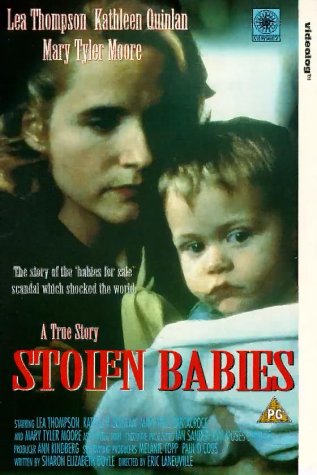
A 1940's Tennessee welfare worker learns that Georgia Tann, the
charismatic head of a local adoption agency, is actually running a
black-market baby ring behind the Tennessee Children's Home Society.
Stolen Babies (1993 TV Movie)
Source: nchgs.org / imdb.com
Subscribe to:
Posts (Atom)

